
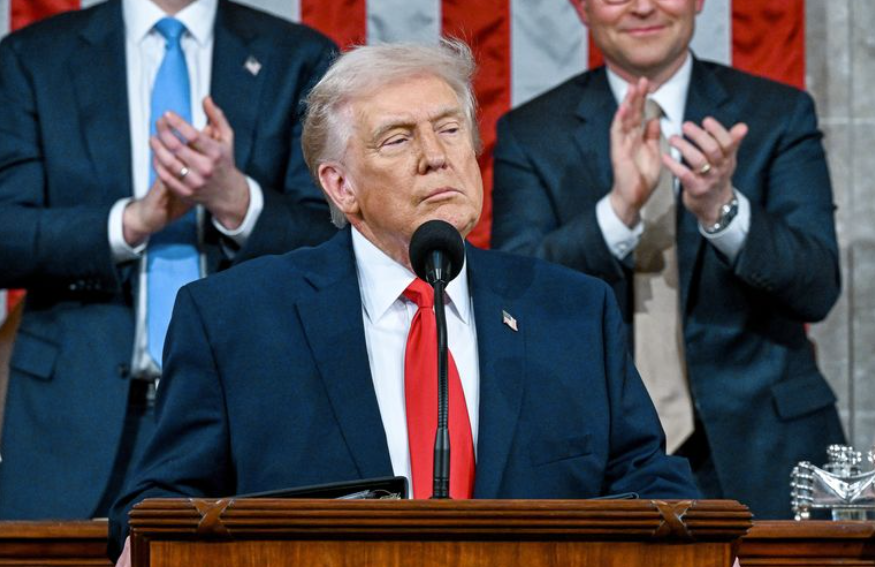
President Donald Trump spoke for 108 minutes during the 2026 State of the Union — the longest address in American history. He covered the economy, foreign policy, manufacturing, and national pride. But for all the words, one of the most consequential issues facing the country was reduced to a single statistic and then set aside.
Immigration — one of the administration’s signature issues — was nearly invisible in the address. A Medill News Service analysis shows the president devoted less than 10% of his remarks to the topic, amounting to roughly ten minutes in total.
And when he did touch on his immigration crackdown, his language stayed firmly in familiar territory.
Trump never used the word “immigrant” a single time during the entire address. Instead, he referenced the border 16 times and used terms like “criminals,” “aliens,” and “illegal” a combined 25 times.

Roughly two minutes of the speech were spent attacking Somali residents of Minnesota, whom he labeled “pirates” and accused of corrupting the state. Rep. Ilhan Omar, D‑Minn., the nation’s first Somali‑American member of Congress, repeatedly yelled at Trump from the chamber floor.
“You have killed Americans,” Omar yelled, referencing the fatal shootings of two Minnesotans, Renee Good and Alex Pretti by ICE agents earlier this year.
Trump then devoted another four minutes to promoting his immigration agenda through stories of Americans harmed by what he called “illegal aliens.”
Trump has repeatedly asserted that rising immigration is driving a surge in crime, but available data does not support that claim. Federal crime statistics do not distinguish offenders by immigration status, yet there is no evidence of any crime wave linked to migrants, whether along the U.S.–Mexico border or in cities experiencing the largest recent arrivals, such as New York and Chicago. Multiple studies using state‑level arrest records show that people living in the U.S. without legal status are, on average, less likely than U.S.-born citizens to be arrested for violent, property, or drug offenses.
The president briefly cited a drop in arrests for illegal border crossings. That was it. No mention of the sweeping enforcement actions underway. No acknowledgment of the human, economic, or legal consequences of the administration’s policies.
This silence is not occurring in a vacuum.
Here is the long list of major initiatives currently reshaping the immigration landscape:
- Expansion of immigration detention
- Continued construction of the border wall
- Efforts to end birthright citizenship
- Denial of bond for people in immigration custody
- Suspension of asylum at the border
- A mass‑deportation campaign that has sparked protests and was linked to two fatal shootings in Minnesota
These are not minor administrative tweaks. The detention expansion and the border wall alone represent nearly $100 billion in federal spending. The scale of ongoing enforcement operations have become a central point of tension in communities across the country.
Yet none of this appeared in the speech.
The omission did not go unnoticed. In the official Democratic response, Virginia Gov. Abigail Spanberger criticized President Trump for his attacks on immigrants: “They have ripped nursing mothers away from their babies. They have sent children, a little boy in a blue bunny hat, children, to far off detention centers. And they have killed American citizens in our streets. And they have done it all with their faces masked from accountability.”
A State of the Union is more than a policy update. It is a declaration of national priorities. When an issue as consequential as immigration is reduced to a single line, it raises questions about transparency and accountability.
In the end, the loudest message on Tuesday night may have been the silence. At a moment when immigration policy is reshaping communities, straining local governments, and prompting legal battles nationwide, Americans were left without clarity on where the administration intends to go next.
A State of the Union is supposed to confront the country’s hardest questions. This year, one of the hardest was left unanswered.
Hugo Balta is the publisher of the Latino News Network, executive editor of The Fulcrum, and twice president of the National Association of Hispanic Journalists.