
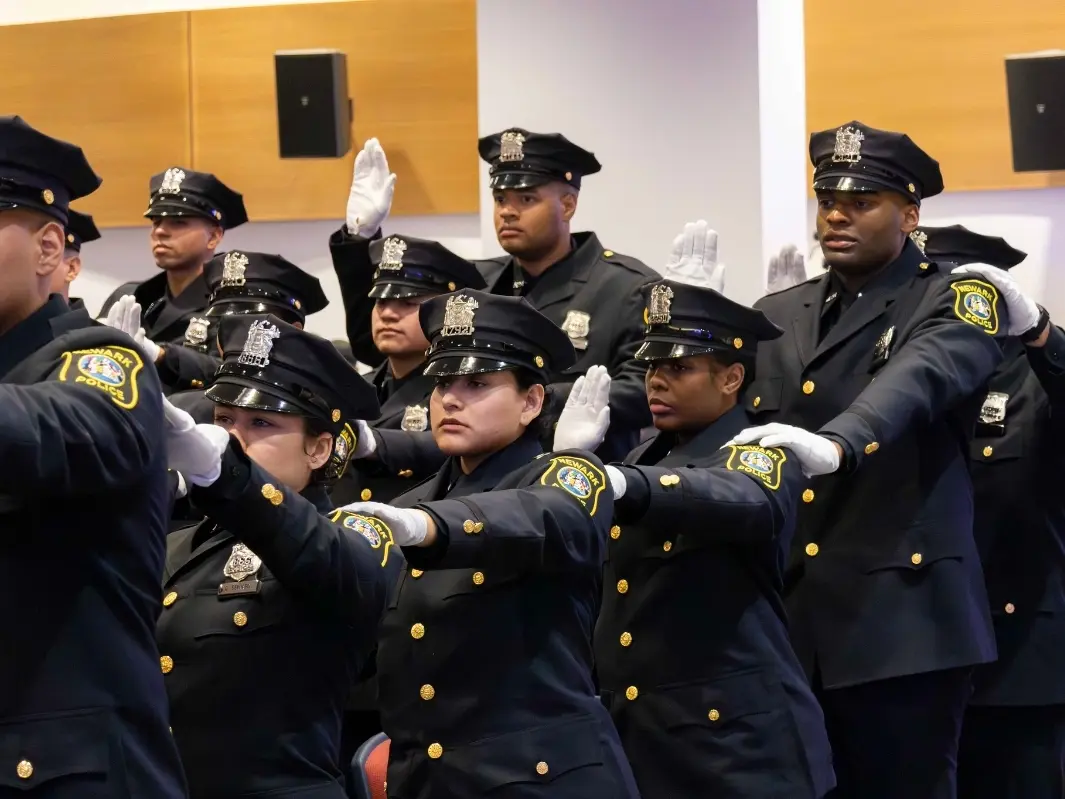
Newark welcomed 45 new police officers into its ranks recently, marking another step toward building a department that reflects the city’s racial and ethnic makeup—particularly its large and growing Hispanic community. The newest class from the William Mobile Ashby Community Care and Training Center includes 28 Hispanic officers, 11 Black officers, and six white officers, according to the Newark Department of Public Safety. Nine of the graduates are women and 36 are men, a distribution that mirrors the longstanding gender imbalance in law enforcement nationwide.
The department’s existing demographics already closely track the city’s population. Before the addition of the new class, Newark employed 1,106 officers, including 542 Hispanic officers—49% of the force—along with 377 Black officers, or 34.1%, and 182 non‑Hispanic white officers, or 16.5%. Census estimates for 2024 show Newark’s population of roughly 317,000 residents was 45.7% Black, non‑Hispanic; 37.6% Hispanic; 12.6% non‑Hispanic white; 2% Asian; and about 2% from other groups.
Newark’s nearly 50% Hispanic representation stands out in New Jersey, where Latino officers remain underrepresented in many departments despite the state’s rapidly growing Hispanic population. Statewide, Latinos make up roughly 22% of New Jersey residents, yet many municipal police forces fall short of that benchmark. Suburban departments—particularly in North and Central Jersey—often report Latino representation in the low teens or single digits, even in towns where Hispanic residents make up a quarter or more of the population. Larger urban departments such as Jersey City, Paterson, and Elizabeth have made progress in recent years, but none match Newark’s scale or pace of diversification. Newark’s numbers place it among the most demographically aligned police forces in the state, especially in terms of Hispanic representation, which in many New Jersey departments still lags behind both local and statewide population trends.
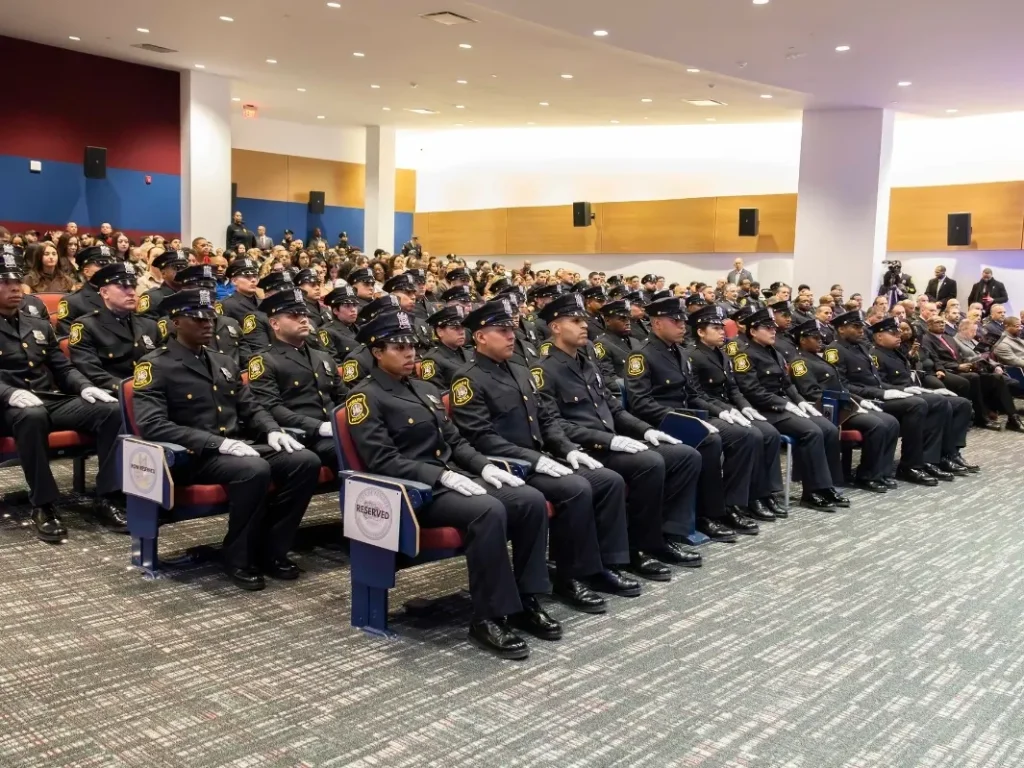
About 200 friends and family members attended last Friday’s ceremony, along with city officials and police leadership. Newark Police Capt. Neil Laurie was among them, watching his son graduate. The event took place in the auditorium of the Bergen Street training center, which opened in 2024 and recently received certification from the New Jersey Police Training Commission to train officers from departments across the state.
The ceremony opened with a drill‑style entrance as the recruits marched in formation down the center aisle, chanting in sharp, forceful tones. They stood at attention in the front rows as bagpipes played, a familiar soundtrack to police ceremonies. Capt. James George, commander of the Newark Police training academy, praised the graduates for completing the demanding program. Their cadet pay of $41,591 will now rise to a first‑year officer salary of $63,902. “You and your classmates came here as individuals,” George said. “But today you stand before us as a team,” reported NJ.com.
City leaders used the moment to reflect on how far the department has come. Public Safety Director Emanuel Miranda, Deputy Mayor for Public Safety Lakeesha Eure, and Mayor Ras J. Baraka all addressed the graduates. Eure pointed to the department’s troubled past, recalling the era when Newark police brutality in the 1960s fueled deadly unrest and contributed to decades of civil rights violations. Those failures eventually led to nine years of federal monitoring, which ended in November after a judge determined that the department had made substantial progress.
Officials credited reforms, data‑driven policing strategies, and violence‑prevention initiatives with helping reduce homicides and other violent crimes in recent years. Eure emphasized that the new officers were joining a force transformed by accountability and community‑focused practices. “This police department is not the police department that it once was,” she said.
With its latest class, Newark continues to distinguish itself within New Jersey as a department whose demographics increasingly mirror the city it serves—an alignment many other municipalities in the state have yet to achieve, particularly when it comes to Latino representation.