
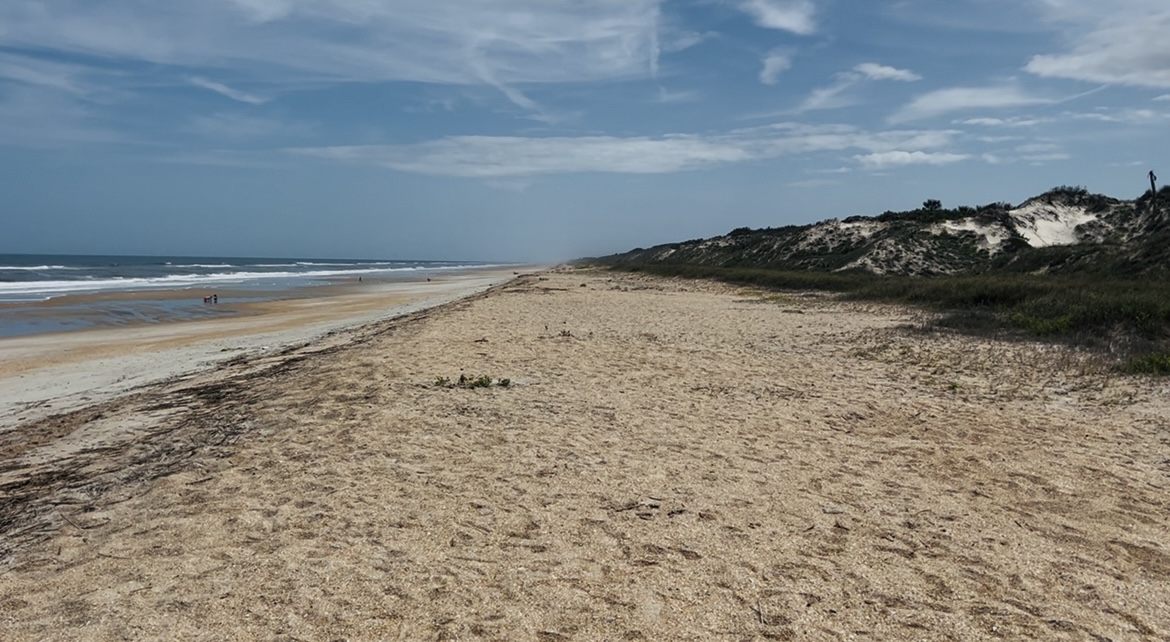
NORTHEAST FLORIDA — The early afternoon sun hung high near Ponte Vedra Beach in St. Johns County by the time I reached a long, quiet stretch of shoreline. My footsteps settled into a steady rhythm as the beachgoers thinned behind me. With the Atlantic whispering to my left and the dunes rising to my right, I felt as if I was, for a moment, the only pilgrim in sight.
I didn’t know what I expected from this journey. Part of me wondered whether it was meant to rekindle something I’d lost—some echo of the Catholic teaching that shaped my childhood. I grew up in a Catholic household, spent my entire schooling in Christian institutions, surrounded by rituals and doctrine woven into the fabric of daily life. But as I grew older, disillusionment crept in. My faith remained strong, but my religion grew thin, like a garment that no longer fit the way it once did.
I also questioned whether this trek was meant to test my endurance. The First Coast Camino—Florida’s officially recognized route connected to the historic Camino de Santiago—stretches roughly thirty miles from Jacksonville Beach to the Cathedral Basilica in St. Augustine. This coastal path has become an increasingly meaningful starting point for American pilgrims preparing for journeys in Spain and Portugal. Was I out here to measure my physical strength, to see how far my legs could carry me, or was the real work happening somewhere deeper, somewhere quieter?
And then another question surfaced: was this journey really about community? About the people I might meet along the way, the ones whose footsteps had already pressed into the sand, and those who would follow long after I passed through? What drew all of us to this path—pilgrims scattered across time—walking the Camino to what end?
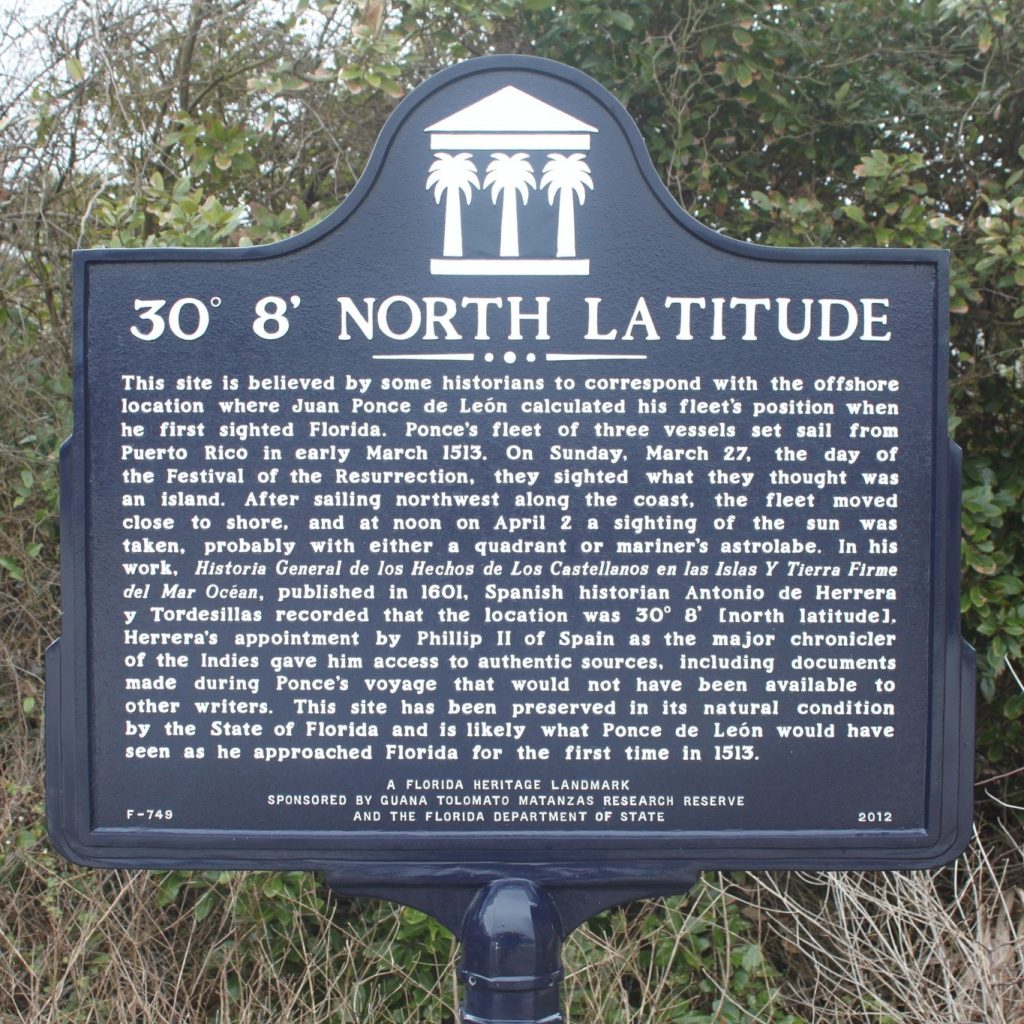
For me, the experience quickly revealed itself as a multi‑dimensional journey. Like countless peregrinos before me, I walked with a blend of faith, reflection, and curiosity. That clarity deepened near the 30° 8’ N mark by the Guana Matanzas Tolomato Estuarine Research Reserve, where the Camino unfolded its quiet power. Research suggests this latitude aligns with the place where Ponce de León first sighted and landed on Florida’s coast, naming the land La Florida and claiming it for Spain on April 3, 1513.
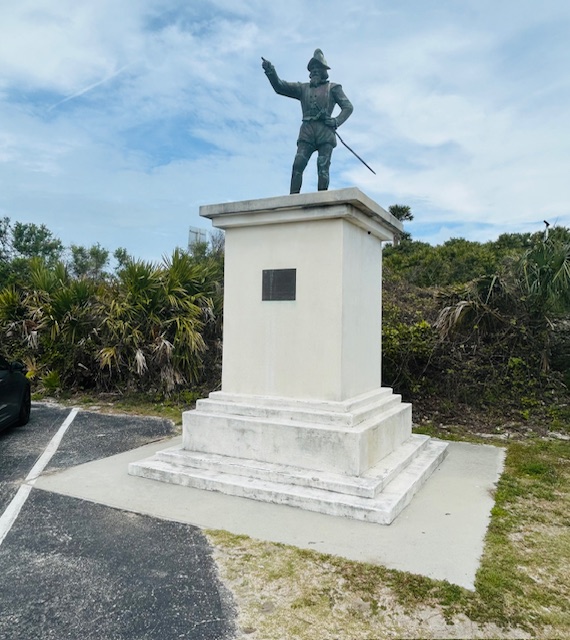
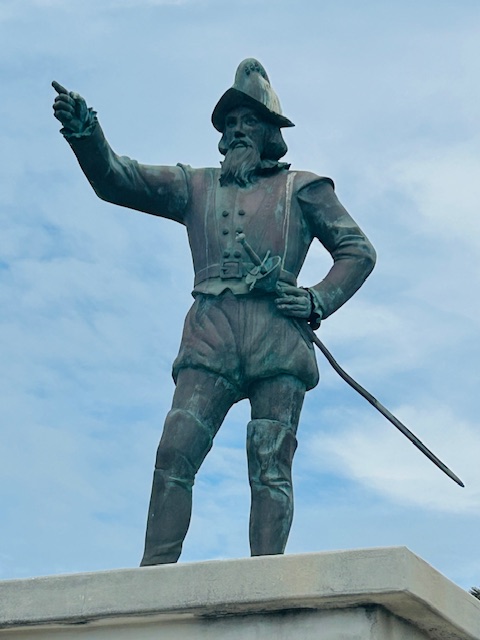
A cast bronze statue of Juan Ponce de Leon pointing to the west at the north parking area of the Guana Matanzas Tolomato Estuarine Research Reserve.
In that solitude, imagining the hopes and ambitions that carried de León and his crew across the ocean, my thoughts drifted naturally to my own family. I thought about my parents, Hugo and Graciela—Peruvian immigrants whose sacrifices and determination inspired me to become a journalist. I thought of my father, now struggling with dementia, and how he always loved long walks, especially along the shoreline. I thought of my wife, Adriana, a two‑time organ transplant recipient whose strength and courage have shaped our lives in ways words can only begin to express. And I thought of my children, Isabella and Esteban, college students, already taking the first strides of their own personal and professional journeys.
The sand was scattered with shell fragments and pieces of coral, and I found myself gathering a few—small treasures, one for each of them, reminders of the journey and the people who give it meaning.
The Camino has long been a path for spiritual seekers pursuing penance, healing, or a closer connection to the divine, and I embraced that tradition as I moved south along the shoreline. Yet the walk also offered space for self‑discovery, providing long stretches of quiet where I could unplug from daily life, reflect on personal challenges, and reconnect with a sense of purpose. The physicality of the route added another layer to the experience. While Florida’s Camino does not cross the Pyrenees or the rolling hills of Galicia, its miles of soft sand and open coastline still demand stamina and intention—an echo of the endurance required on the European routes.
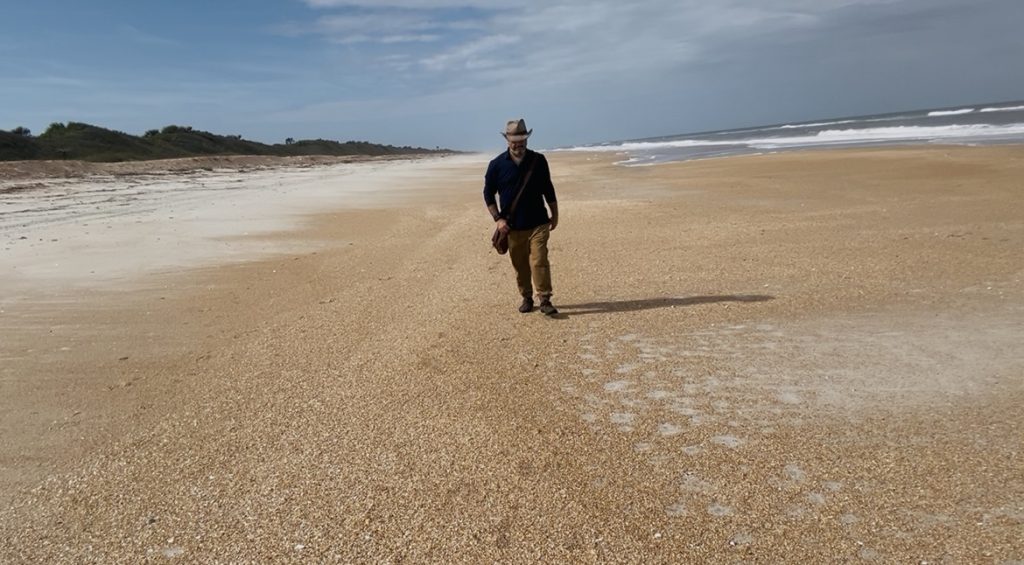
Hugo Balta walking The First Coast Camino—Florida’s officially recognized route connected to the historic Camino de Santiago
Florida’s connection to the Camino de Santiago continues to deepen as more walkers choose the First Coast to begin their pilgrimage experience. The First Coast Camino also known as the Camino de las Américas, the route can be walked year‑round and offers a blend of spiritual reflection, natural beauty, and historical significance. Pilgrims may begin at the Cathedral Basilica of St. Augustine—the official year‑round starting point—or at St. Paul’s Catholic Church in Jacksonville Beach, allowing them to complete the full 30‑mile trek at their own pace.
The Cathedral Basilica of St. Augustine, located in the heart of the nation’s oldest city, stands as the spiritual center of the Diocese of St. Augustine and the oldest Catholic parish in the continental United States. Established with the city’s founding in 1565, the parish has been a continuous thread of Catholic life on Florida’s First Coast for more than four centuries. The present cathedral—an elegant blend of Spanish Colonial and Renaissance Revival architecture—was completed in the late 18th century and later designated a U.S. National Historic Landmark. Today it remains an active, vibrant parish, offering daily Mass, reconciliation, and Eucharistic adoration, while welcoming pilgrims and visitors who come to experience its history, its beauty, and its enduring role as a beacon of faith in America’s oldest Catholic community.
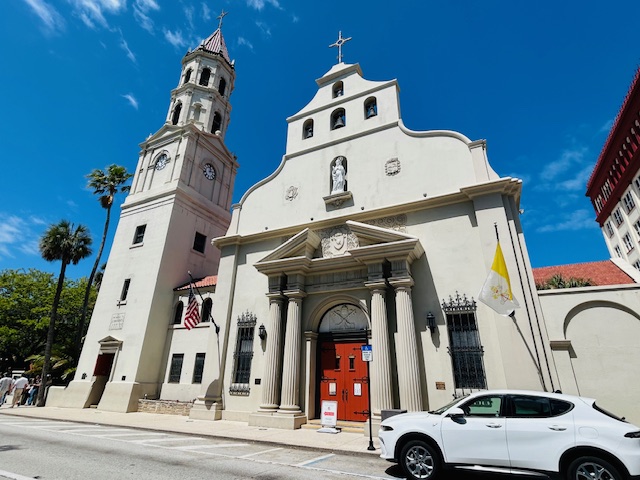
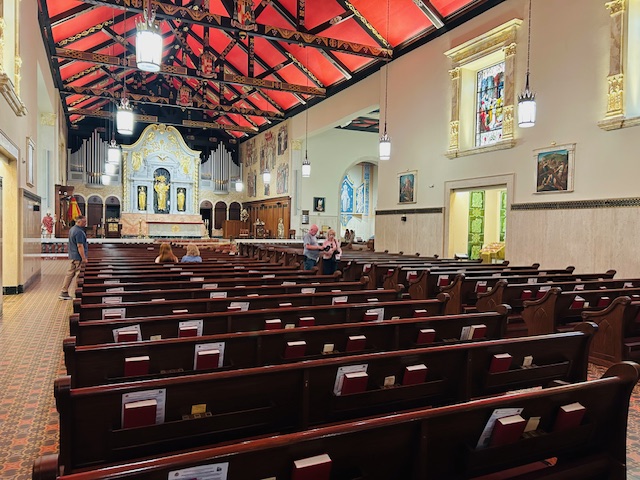
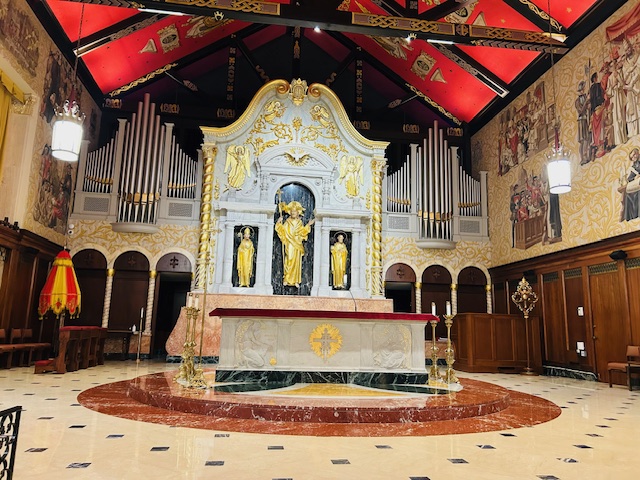
Cathedral Basilica in St. Augustine
The Trusted Tours & Attractions tour guide explained to me that the basilica’s ceiling is painted red to reflect traditional Spanish design influences, a color historically associated with warmth, reverence, and the architectural heritage brought to St. Augustine by its early settlers.
Along the way, walkers collect stamps in their pilgrim credentials, known as Camino passports, which are available at the Cathedral Basilica Bell Tower Gift Shop.
One can also collect stamps at the First Coast Cultural Center in Ponte Vedra. It serves as a reminder that this coastline is not only a place of natural beauty but also a community shaped by imagination, learning, and the shared stories that give the region its character. As a hub for arts education, exhibitions, and hands‑on programs, it offers residents and visitors a place to explore new ideas, engage with local talent, and experience the arts in ways that deepen their connection to the First Coast.
Silvia Romero, Senior Director of Operations at the First Coast Cultural Center, said the organization’s mission is grounded in the belief that the arts should be accessible to everyone. “We exist to nurture creativity, support local artists, and provide a welcoming space where the community can learn and connect,” she shared with me.
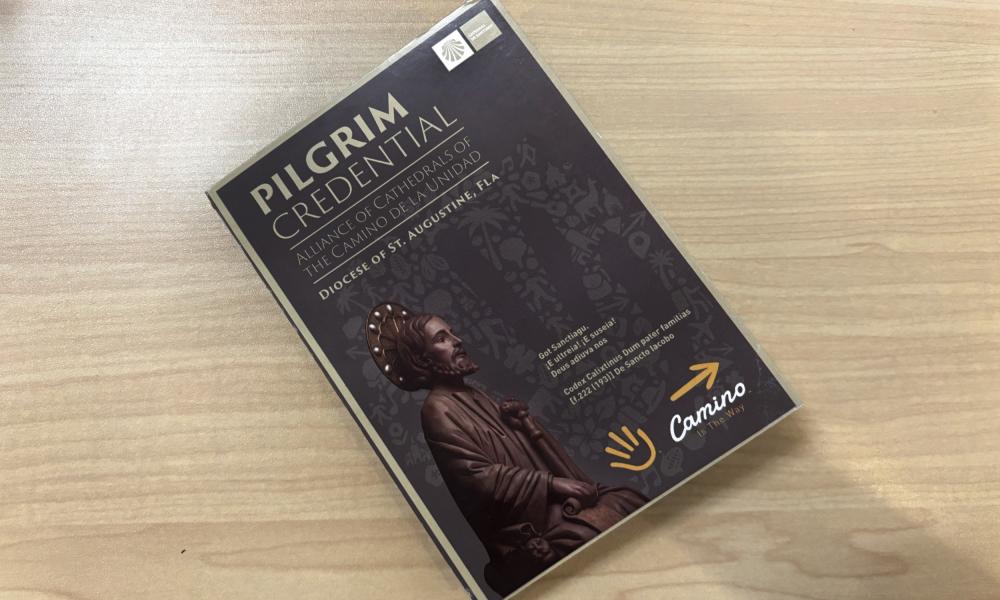
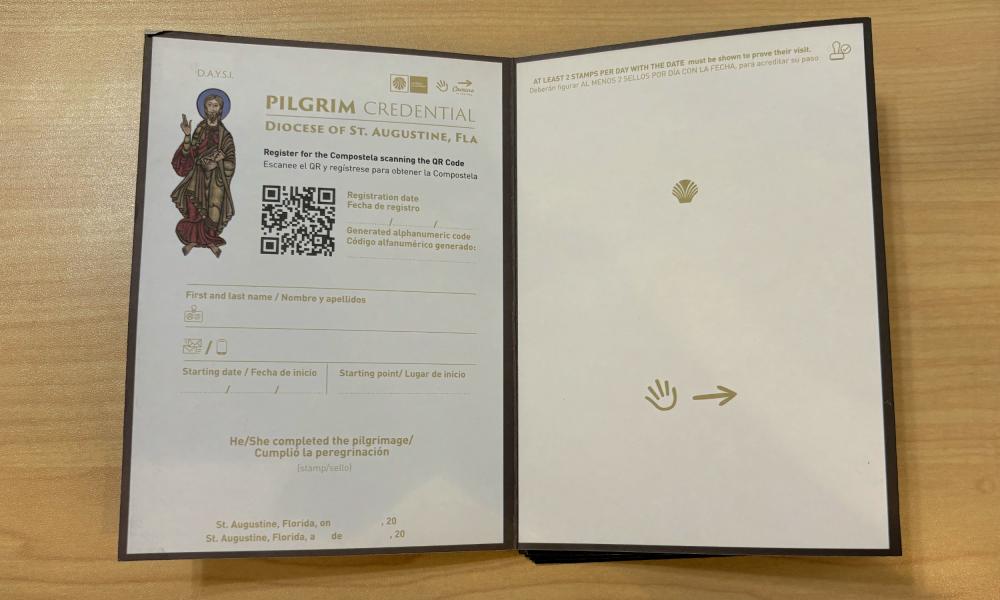
Special passports for the Camino de Santiago (Credit: visitstaugustine.com)
In addition to offering the $10 passports, there’s also an app called “Camino Is The Way,” which maps out the various First Coast routes. The app’s GPS feature lets you track your progress in real time. Just search Camino Is The Way in your app store. Once downloaded, you can register and manage your official QR code in the credential section—just as pilgrims do through the Catedral de Santiago.
Through a partnership with the Order of Malta’s Baby Steps Camino®, miles walked in Florida can be applied toward the 100‑kilometer requirement needed to earn a Compostela certificate in Spain. Digital stamps, collected via mobile apps at sites such as the National Shrine of Our Lady of La Leche, have become a modern extension of the tradition.
Our Lady of La Leche and the Mission Nombre de Dios sit quietly along the Matanzas River, on the very ground where Spanish settlers first arrived in 1565 and celebrated the first recorded Catholic Mass in what would become the United States. Today, the mission’s oak‑shaded paths, historic chapels, and sweeping waterfront create a sanctuary of peace that feels worlds away from the bustle of St. Augustine. At its heart stands the Shrine of Our Lady of La Leche, where generations have come seeking comfort, healing, and hope—a place where the centuries‑old thread of faith remains unbroken, inviting modern pilgrims to pause, breathe, and feel the weight of history settle gently around them.
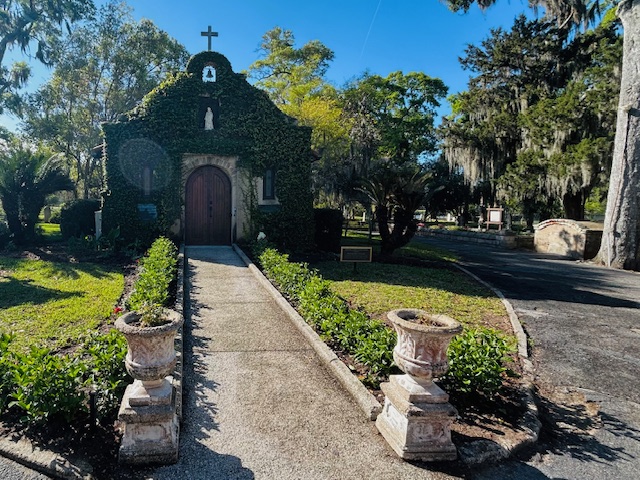
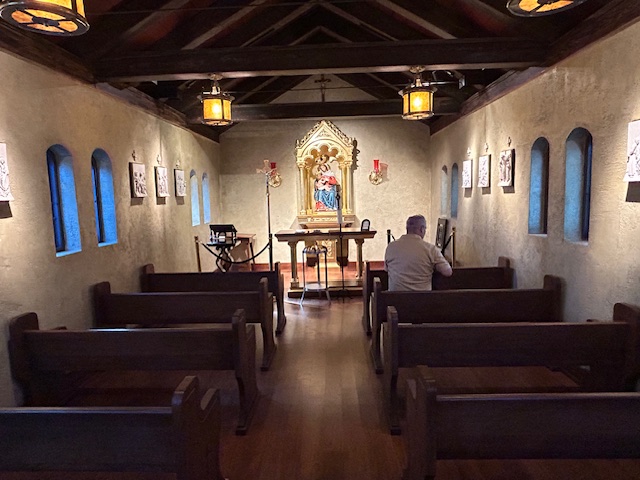
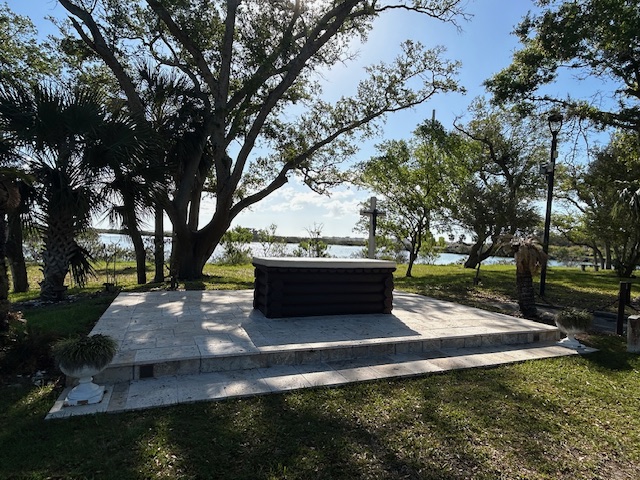
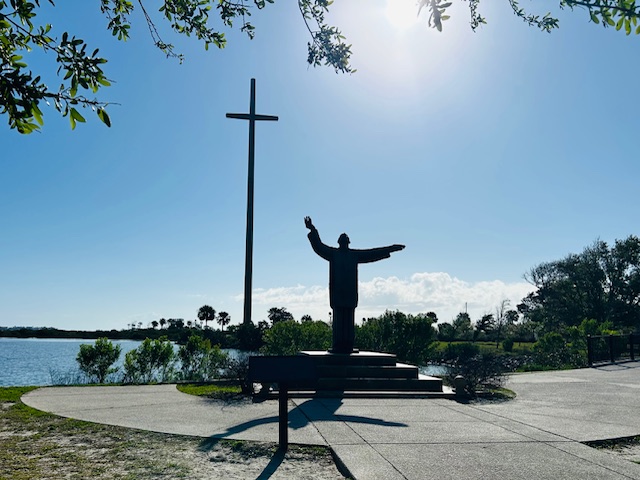
Our Lady of La Leche and the Mission Nombre de Dios.
That’s where I met Bob and Maria Alvarez of the Historic Florida Militia, a nonprofit in St. Augustine dedicated to preserving the city’s layered colonial past through living‑history reenactments, educational programs, and community events. The couple, both seasoned historical re‑enactors, have walked the Camino not only here in Florida but also along its storied routes in Europe, carrying with them a deep appreciation for the traditions and stories that shape each pilgrimage.
“You walk through life. You walk the Camino,” said Bob Alvarez. “You will have good days and bad days. You’ll have sunny days. You’ll have rainy days. You’ll have hills to climb. You’ll have leveled ground. You’ll see pretty flowers. You’ll see highways. It’s all this stuff together. So, it’s actually a metaphor for life. And when you walk the Camino, you realize that this is what life is all about.”
The First Coast Camino also offers the cultural immersion that defines Camino routes worldwide. It connects pilgrims with centuries‑old Catholic heritage, historic architecture, and the rhythms of coastal communities. Even in Florida, the Camino remains a form of “slow travel,” encouraging walkers to notice details, appreciate local traditions, and engage with the landscape at a human pace. And like every Camino, the journey is shaped by community—the brief conversations, the shared nods of recognition, and the small acts of kindness that often become the most enduring memories.
While the route is open year‑round for individual pilgrims, organized group walks take place throughout the year. The 2026 calendar reflects St. Augustine’s growing role as a U.S. gateway to the global Camino movement, including the Diocese of St. Augustine’s 100‑mile “Path of Kindness” pilgrimage in April and the National Eucharistic Pilgrimage’s Cabrini Route launching from St. Augustine on Memorial Day weekend. The Baby Steps Camino®, an annual Advent tradition, will continue in 2026 with group walks scheduled for December 4 and December 6.
Each year, the First Coast Camino also marks a symbolic milestone on July 25, the feast of St. James, often celebrated with a procession in St. Augustine that highlights the city’s deep Catholic and Hispanic heritage.
For me—and for many others—the Florida Camino offers a meaningful alternative close to home. Whether walking for faith, clarity, challenge, culture, or connection, the Camino continues to meet pilgrims where they are and offer what they seek. Maria Alvarez shared her hopes for those who travel the Camino, whether along the ancient routes of Galicia or the sandy shores of the First Coast. “I hope people meet others along the way who open their minds a little—who help them see things from a different perspective and not be so closed off,” she said.
Hugo Balta is the publisher of the Latino News Network, the executive editor of The Fulcrum , and twice president of the National Association of Hispanic Journalists.
Editor’s Note: This article was made possible in part through the support of St. Augustine, Ponte Vedra & The Beaches VCB and ENroute Communications.