
Exactly one week before his Apple Music Super Bowl LX Halftime Show performance, Bad Bunny made history at the 68th Grammy Awards after his latest studio album, DeBÍ TiRAR MáS FOTos, became the first Spanish-language project to win Album of the Year in Grammy history. Despite facing heavy criticisms that expose existing socio-cultural tensions in the U.S., Bad Bunny, born Benito Ocasio, will continue to make history as the first Spanish-language solo headliner at the Halftime Show, bridging sociocultural divides in the most Boricua way: through song and dance.
The NFL’s announcement of this year’s Super Bowl headliner in late September drew significant criticism, particularly from American audiences.
American officials, such as President Trump and U.S. Secretary of Homeland Security Kristi Noem, have spoken out, the former labelling Bad Bunny and Green Day, the supporting Halftime Show performance, as “a terrible choice.” Moreover, the American public has been vocal about their distaste for the artist, denouncing his performance as part of the “woke agenda.”
Tomi Lahren, a Fox News commentator and conservative podcast host, went viral in October for claiming that Bad Bunny was not an “American artist,” despite the fact that he is Puerto Rican, and all Puerto Ricans are U.S. citizens. She later clarified that she considers him to be un-American due to his anti-ICE political stance. Her statements broadly echo those of many U.S. citizens, who define being American through a conservative interpretation of what it means to uphold American values (i.e., speaking English, adhering to traditional gender norms, observing the Christian faith).

Despite these criticisms and claims of divisiveness, Bad Bunny aims to spread an agenda of unity and love, replacing cultural purity narratives with a celebration of diverse cultures and perspectives. This includes not treating Hispanics and Latinos as second-class citizens.
“Before I say thanks to God, I’m gonna say ICE out,” began Ocasio, after accepting his award for Best Música Urbana Album at Sunday evening’s Grammy ceremony. His statement was met by a 30-second-long chorus of applause and cheers from the audience.
“We’re not savage, we’re not animals, we’re not aliens, we are humans, and we are Americans,” he continued. “The only thing that is more powerful than hate is love. So, please, we need to be different. If we fight, we have to do it with love. We don’t hate them, we love our people, we love our family, and that’s the way to do it. With love.”
In later speeches, he affirmed his love for Puerto Rico and the inherent pride in being Boricua. He extended this pride to the Latino-Hispanic community as a whole.
“I want to dedicate this award to all the people who had to leave their homeland and country to follow their dreams,” said Ocasio. “To all the dreamers, to everyone who has lost a loved one and still had to move forward and carry on with great strength, this award is for you. Thank you for all the love. I love you. To all the Latinos around the entire world, to all the artists that were here before and deserved to be on stage receiving this award, thank you very much.”
Bad Bunny delivered his message in Spanish, a significant move in a climate where racial profiling and prejudice, often based on looks and language, can result in federal deportation action.
“I think that for me and many other Latinos, not only is the Bad Bunny win deeply personal, but I think it is very empowering, and it brings so much hope during a time where Latinos are constantly under attack. The immigrant community is being persecuted, and it can feel so heavy to be a Latino. I think this win is for all of us,” said Lilian Martinez, a Maryland-born Salvadoran and long-time Bad Bunny fan.
Nathan Bas’ Evans, a visual artist also from the DC area, affirms the significance of Bad Bunny’s success.
“I think that Bad Bunny’s awards matter because they mark a shift from acceptance to recognition of Latino culture,“ Evans said. “By winning, he affirmed that Latino voices do not need permission to belong in the global culture. It already does. I think he’s just the evidence of excellence.”
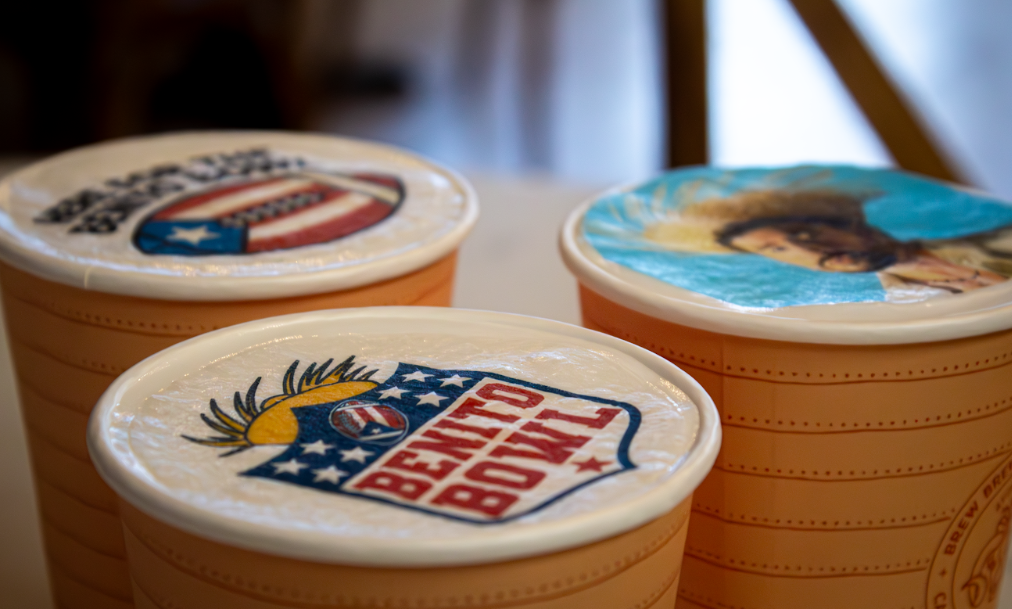
A microcosm of Bad Bunny’s sociocultural impact can be found at Brew Brew Coffee and Tea, a Mexican-owned, Chicago-based cafe that launched a line of Benito Bowl-themed drinks and cookies yesterday morning.
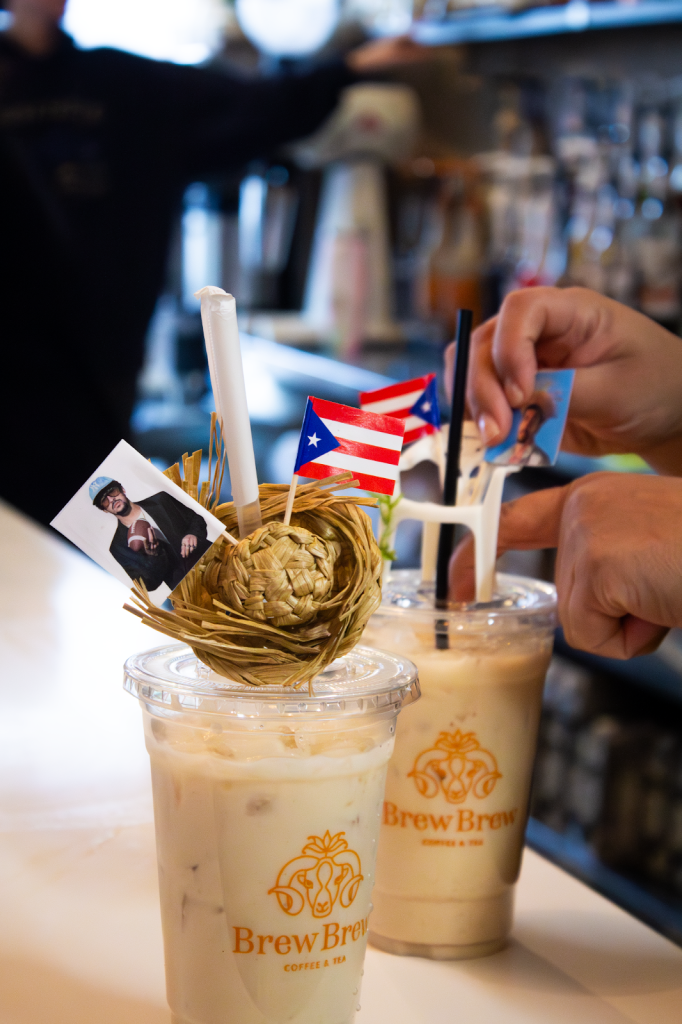
Jazmin Medrano decorates the Bad Bunny-inspired coquito-flavored lattes. Both lattes feature a Puerto Rican flag and a photo of Bad Bunny, but one is decorated with a traditional Puerto Rican pava hat, which Bad Bunny wears in his promotional materials, and the other with a lawn chair seen on the DTMF album cover. By Britton Struthers-Lugo, Feb. 5, 2026.
Though not a huge fan of Ocasio’s music herself, Brew Brew owner Jazmin Medrano noticed the buzz surrounding the artist’s recent success and thought that her customers might appreciate a fun way to celebrate it. As it turns out, this was an understatement – the lattes and cookies sold out within an hour and a half of opening.
“I can’t believe it,” said Medrano, shocked by the popularity of the Benito Latte. “We used to be popular with the Bears; we did a [latte] topper for the Bears. But this is way beyond.”
It wasn’t just Puerto Ricans lining up to buy the lattes, though.
“You saw Americans, and you saw all people around, of different colors,” said Medrano.
The immense popularity of this latte among a diverse range of customers is not only a reflection of Bad Bunny’s global dominance in pop culture but also of his music’s ability to transcend linguistic and cultural boundaries and unite people through dance and celebration.
Evan Alicea Guivas, a Puerto Rican employee of Brew Brew Coffee and Tea, said that seeing Bad Bunny’s success and the unity it has brought to the Latino and Hispanic community fills him with pride.
“It’s incredibly important, I think, especially after certain things have been said about the island and, like, our people. For him to come out and just spread a message of love. I think it’s impressive,” said Guivas. “I wish my grandma was here to see it.”
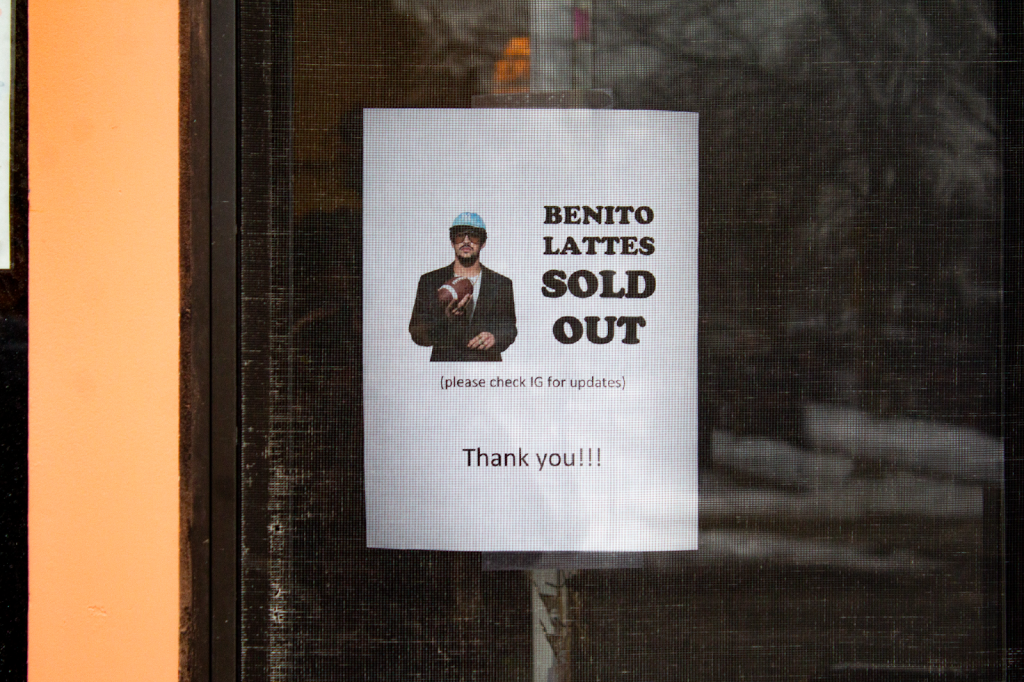
While Brew Brew Coffee and Tea sold out of their Benito Lattes and cookies early Wednesday morning, they are preparing to sell more this Sunday. Guivas advises those in the Chicago area who want lattes to come early and dress warmly, as there might be lines out the door. By Britton Struthers-Lugo. Feb. 5, 2026.
Martinez echoes this sentiment of pride and excitement, and she feels as though Bad Bunny is leading the way to show everyone who tunes in to the halftime show that Hispanics and Latinos are greater than the sum of the depreciatory headlines in the media.
“I think now, more than ever, is the perfect time for him to go on that Super Bowl stage and not only unite Latinos, but unite everyone who will be watching and listening.”