
Tel Aviv – Sylvia Cunio wipes a tear from her eye — but this time, a happy one, as she looks forward to the future with her family in southern Israel. ‘’Es un otra vida,’’ says the matriarch of an Argentinian-Israeli family, a beginning of a new life.
Cunio’s ‘’eternal fatigue’’ came to an end when her two sons, Ariel and David, were released from Gaza and reunited with their family after 738 days in captivity. Both brothers had been held hostage by Hamas after their deadly attack on southern Israel on Oct. 7, 2023.
The Cunio family lived in Nir Oz, a kibbutz about 1.5 miles from the Gaza border and among the hardest hit during the attacks. To Cunio, the kibbutz had always felt like “paradise” — a tight-knit community where neighbors helped one another and families gathered for dinner together each evening.
This “paradise” lifestyle was quickly upended when Hamas militants captured not only Cunio’s sons, but also Ariel’s girlfriend, Arbel Yehoud; David’s wife, Sharon Aloni-Cunio; the couple’s 3-year-old twin daughters; and Sharon’s sister, Danielle Aloni, along with her daughter, Amelia, who were in town visiting for the Jewish holiday.

‘’It’s beautiful to live in a kibbutz because [of] the tranquility,’’ Cunio says. ‘’The peace that there is in kibbutz, it’s the most beautiful thing.’’
During the massacre that day, some 1,200 Israelís were killed, and more than 250 were kidnapped and taken back to Gaza.
The Aloni sisters, twin daughters, and Amelia were released in November 2023. Yehoud was released in January 2025. After multiple rounds of ceasefires and rounds of releases, surviving hostages were able to confirm to the Cunio’s that Ariel and David were still alive. The Cunio family was just happy to hear about signs of life.
“David was with other people, who were the ones who told us when they were released,’’ Cunio says. “They told us that David was well, that he was alive, that he had sent greetings to everyone.”
The uncertainty of her son’s safety and life weighed on her each day. “The things that go through your head are impressive,” Cunio says.
Speaking at rallies and sharing messages brought her comfort during such a trying time.
‘‘That’s what helped me to move forward and keep fighting for the lives of my children until they were returned, ‘’ Cunio says. ‘’Talk about them. Tell our story.’’
While families like Cunio are still navigating the long aftermath of the war, so are the members of the Israel Defense Forces (IDF).
Some have dedicated themselves to speaking each day about not only kidnapped soldiers, but also others who were killed during the Oct. 7th attack. Sergeant O, a military observer, lost multiple close friends during the attack and, similar to Cunio, has honored their legacy by talking about them each day.
‘’I have this mission, and now the mission is to make sure that they’re not forgotten, ‘’ says Sergeant O, who cannot be identified by her full name or show her face in photographs due to an IDF-wide mandate for soldiers below the rank of colonel citing security concerns.
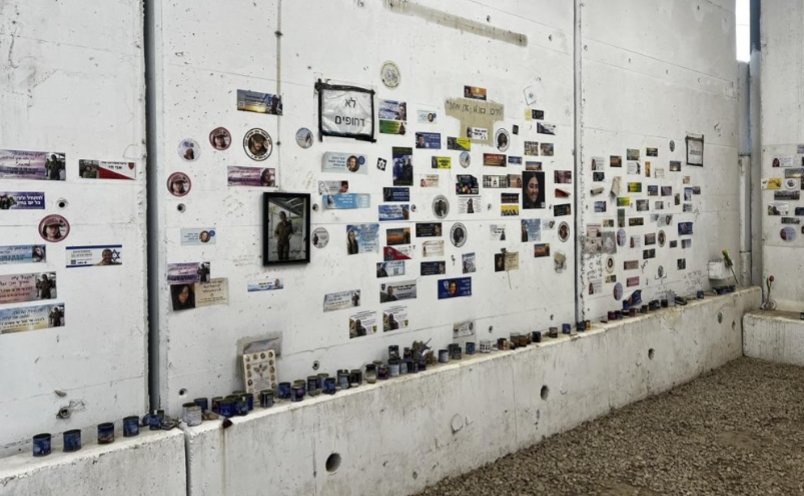
Walking through the military base Nahal Oz, one of the IDF’s facilities hit hardest on October 7th, the atmosphere remains dark and heavy. Bullet holes mark the walls, and ashes from the fires still cover the ground. Yet even amid these reminders, Sergeant O continues to share the stories of soldiers and friends whose lives were lost there.
As she moves through the scarred base, Sergeant O says her mission goes beyond keeping their memory alive. She wants to show the world that the IDF is not just a powerful military force, but also a “5’2’’ brunette girl who just wants to protect her country.”
“It’s not glamorous, but it’s an honor,” says Sergeant O of her duty to lead tours through the base where 53 soldiers were killed, including 16 female surveillance soldiers who were unarmed. Ten others were taken hostage.
The weight of these memories doesn’t end with the survivors who lived through October 7th. It extends to the people trying to help them rebuild. Behind closed doors, therapists, social workers, and mental-health teams have become part of the recovery story—guiding soldiers, families, and entire communities through trauma that Israel has never faced at this scale.
Across the country, Israelis are receiving support from clinicians and government programs designed to help them process what happened and begin healing.
Einat Kaufman, PhD, Head of the Psychotrauma Crisis and Response Unit at United Hatzalah of Israel, is a renowned psychotherapist and international expert in trauma who has travelled all over the world to help others heal, including victims of tragedies like a residential condo collapse in Surfside, Florida, and survivors of Hurricane Ian on that state’s West Coast.
Though she treats patients around the world, a big part of her work now has been helping families, hostages, and traumatized Israelis navigate their emotions throughout the war and its aftermath.
According to Kaufman, PTSD will not fully kick in in Israel until 6 months after trauma, like war, has ended.
‘’We’re still in the middle of trauma. Because every moment, everything changes,’’ Kaufman explains.
Marissa Muniz is a senior at Baylor University. She completed this piece as a media fellow with Fuente Latina.