 Skip to content
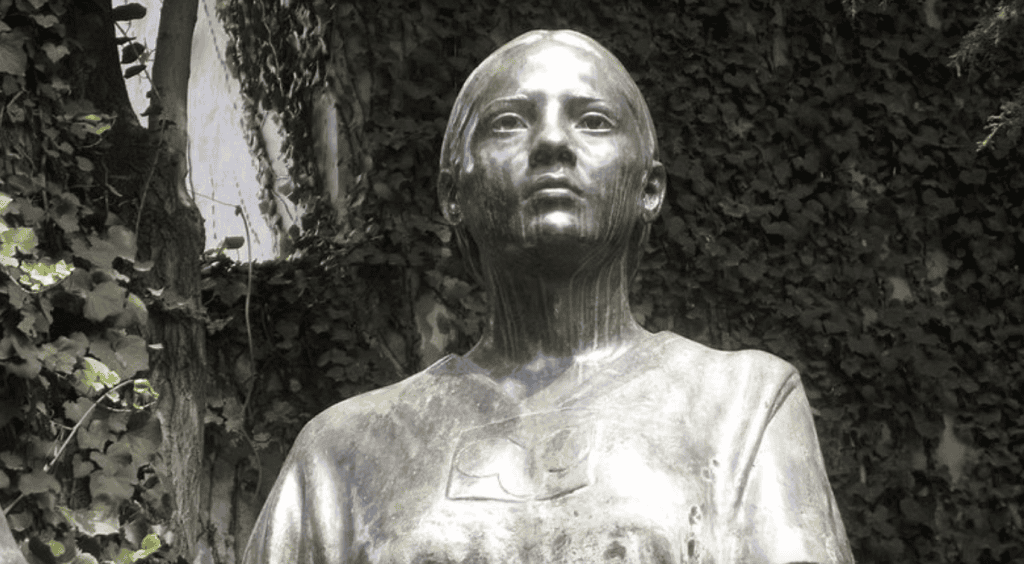
Sometimes it takes centuries to discover who you are.
This Women’s History Month, I honor Malinche, one of the most controversial women in Mexico’s history. In my work over 25 years to discover and tell her story
For over 500 years, Malinche has been brutally portrayed as the whore and ally of the Spanish conquistador Hernán Cortés. She was thrown into his path, gifted to him along with 19 other women, in 1519. Her mastery of languages made her valuable to him and also put a target on her back.
Over time, this young, Indigenous woman became propagandized as the main instigator behind the downfall of the Mexica/Aztec empire. This trafficked teen bravely interpreted words for Cortés and Moctezuma, and because of that, has been blamed for the colonization of Mexico for the last five centuries.

A movement to reframe Malinche’s story in Mexico began last year with cultural events to celebrate National Indigenous Peoples’ Day. President of Mexico Claudia Sheinbaum told reporters, “We have a working group of anthropologists, historians, and philosophers studying this important, much-maligned figure, and it is very important to vindicate her.”
Understanding Malinche’s life is especially critical today. A global culture where women and girls are routinely sex trafficked extends far beyond the heinous acts of Jeffrey Epstein and his cowardly associates. Throughout history and today, women and children who have been victimized are robbed of their voices and humanity by the powerful and connected. It was recently reported that Cesar Chavez, icon of the Chicano civil rights movement, groomed and assaulted minor girls and raped and abused renowned Latina activist Dolores Huerta. Secrets that have been kept by the survivors for decades sent shockwaves throughout the Latino community.
As a Mexican-American woman growing up in the 60s in a middle-class suburb of Chicago, I thought Malinche was one of those Mexican words– like cabrona; words you never said out loud because you would get into trouble. As people believed she was responsible for the destruction of an empire, her name was spoken with as much condemnation as a swear word.
My father was born in Monterrey, Mexico, and came to the United States as a journalist in 1949. My mom was born in a Chicago neighborhood that was razed to make way for the University of Illinois at Chicago campus; her parents were from Jalisco, Mexico.
I grew up hearing Spanish but speaking in English because my mother was afraid her children would be marginalized. Spanish was the language of my father’s heart and his work as a radio announcer. It was the code my mother and I spoke when we didn’t want people around us to know what we were talking about.
By the time I was in my teens in the 70s, I knew Malinche was the name of Cortés’s interpreter during the Spaniards’ conquest of what is now known as Mexico.
After I read the Spaniard Bernal Díaz del Castillo’s True History of the Conquest of New Spain, her story was still vague, but a few things struck me: she was handed over to Cortés as a war prize at 18, she was fluent in three languages and the Spaniards named her Marina. She quickly gained fluency in Spanish during her journey to reach Moctezuma and the city of Tenochtitlan. She survived the Spaniards’ destruction of that magnificent city and Mexico.
Díaz writes that “she betrayed no weakness but a courage greater than that of a woman.”
I needed to know more about this young woman who was able to speak for armies, captains, ambassadors and royalty. My obsession with Malinche led me to later write a novel about her, Malinalli, her Nahuatl name.
There are no letters or journals in her voice, so everything is filtered through the eyes of the Spaniards, including Cortés and Diaz, who wrote first-person accounts of the conquest, and the Dominicans and Franciscans who arrived years after Tenochtitlan, today’s Mexico City, fell.
Cortés mentions her only twice in five self-glorifying letters to his Emperor Charles V of Spain; in one letter, calling her Marina, and la lengua, the tongue or interpreter.
The local chieftains called her Malintzin (which the Spaniards misheard and mispronounced as Malinche) and Malinalli. Some people thought she might be an ancient sorceress named Malinalxochitl or Wild Grass Flower.
I read everything I could find about Mesoamerican matriarchal cultures, Tenochtitlan, anthropological and archeological records, studies, and Mesoamerican histories, both ancient and recent. I read the stories of Mesoamerican gods and goddesses – Malinalxochitl, Huitzilopochtli, Ix Chel ––with fantastical tales that rival the Greeks’ Zeus, Athena, and Mars.
For years, I wrote drafts of her story in my free time from my advertising career, creating six versions of my novel. I needed to tell this story about how awe-inspiring Malinche was.
I relished the research and writing without fully realizing that I was digging into the history of my father’s and grandparents’ homeland, la patria, and that I was unearthing my connection to my Latinidad. The more I engaged in my heroine’s world to capture it through her eyes, the more I could see myself more clearly.
I am Mexican. Soy Mexicana. But then I wondered if I was Mexican enough to tell this story. Voices from the past haunted me.
“La gringa,” they called me, the American. And la güera.
I heard these names hurled at me in the U.S. and in Mexico throughout my childhood and young adulthood. Today I interpret güera to mean “the white girl,” but it was a word I didn’t fully understand when I was young. The word was not spoken with love.
I wondered if people called my green-eyed mother güera to her face, or my maternal grandmother Jesús, whose naturalization papers described her as White, complexion Fair; or my paternal grandmother, Adela, whose embrace was soft and smelled like warm pan dulce.
Veronica Chapa is the author of the award-winning novel Malinalli.
