Skip to content

September marks a special time for many Latinos. For a whole month, starting on September 15, everyone is invited to celebrate Hispanic Heritage Month. Piñatas, sambas, and piraguas are the order of the day. Yet, as many instructors prepare to teach the first days of class, both Latinos and non-Latinos alike would do well to remember that September 16 is also National GED Day. As I plan my first lessons of the academic year for my GED students (en español), I cannot help but ponder the exam’s history, its promises, and its pitfalls. Even if imperfect, exclusionary—perhaps even biased—the GED remains a lifeline for many who want to get ahead professionally. Here is the snapshot of the test’s past and present for those who would benefit from it.
The GED, or General Educational Development test, consists of four academic subject exams (Reasoning Through Language Arts, Mathematical Reasoning, Science, and Social Studies) that certifies one’s high school-level aptitudes. The assessment originated at the close of World War II, when the U.S. wondered: how would returning veterans, most without diplomas, reintegrate into civil society? Some G.I.s, while still stationed abroad, were offered the test as early as 1945. In 1947, New York became the first state to offer the exam to the general public. The now-infamous TLC network even broadcast programming meant to prepare watchers for the test. Roughly twenty year later, around 1967, Spanish-speakers in New York and New Jersey made novel demands about the education opportunities afforded to them. Indeed, the 1960s were defined by the Los Angeles Blowouts, the Delano Grape Strike, and yes, even West Side Story. According to the American Council of Education, which administers the test nationally, Puerto Ricans in the Tri-State area led the charge. 1969 saw the first examiners to take the GED en español, although newspapers around NYC and Puerto Rico advertised the novel option for learners even earlier. By 1972, Boston newspapers were sharing the good news. A Bay State Banner article published on November 2, 1972 reports that 21 new graduates range “in age from 18 to 41 [and] represent Colombia, Cuba, the Dominican Republic, Ecuador, Panama, Peru, and Puerto Rico.” Various columns in San Juan’s El Mundo provide cautionary tales about WWII veterans who, having passed the exam while overseas, lose track of their credentials. The GED was, and still is, a means of advancing one’s professional horizons—for both English- and Spanish-speakers.
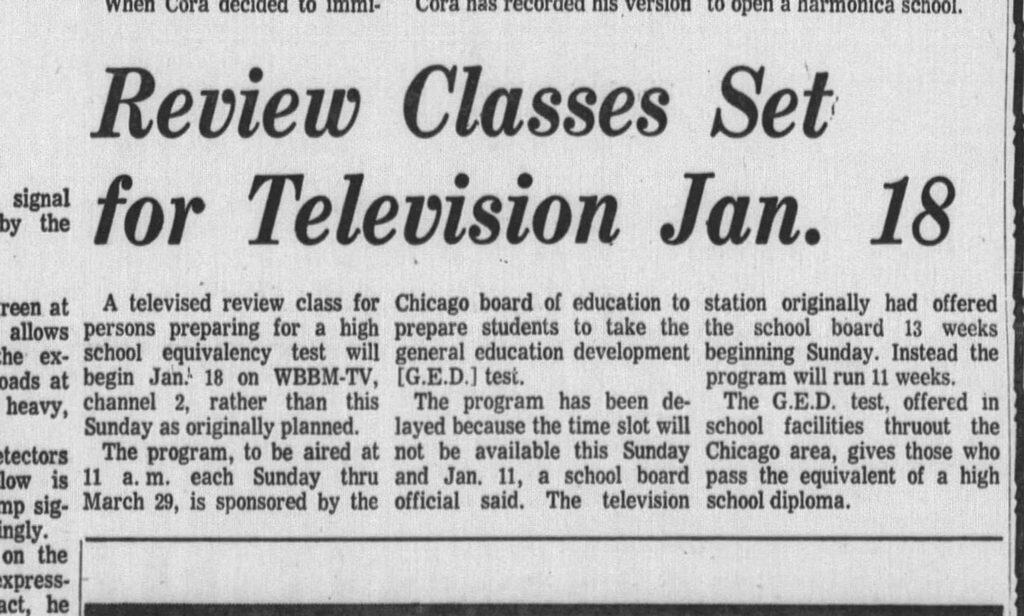
Chicago Tribune, Jan. 1, 1970
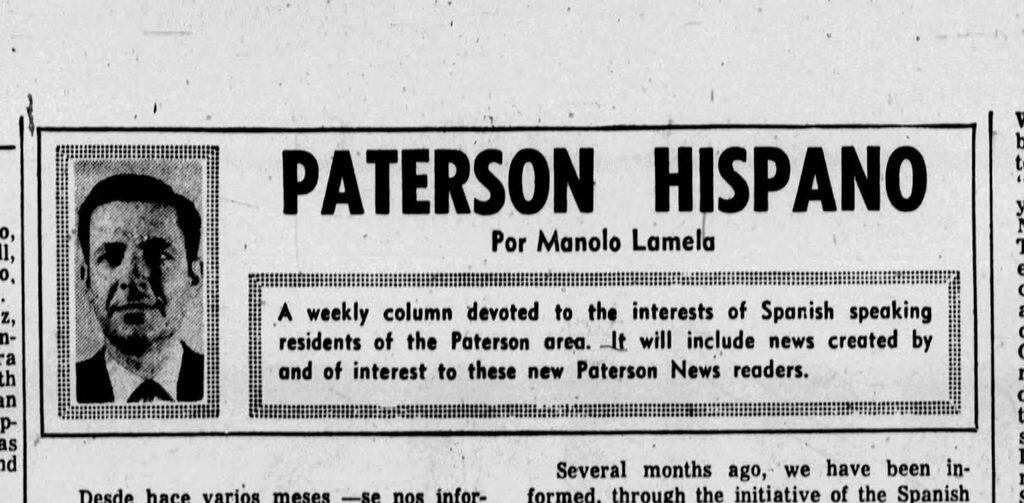
The News. Paterson, New Jersey, Sept. 28, 1968. Among the first papers to publicize the Spanish-language GED

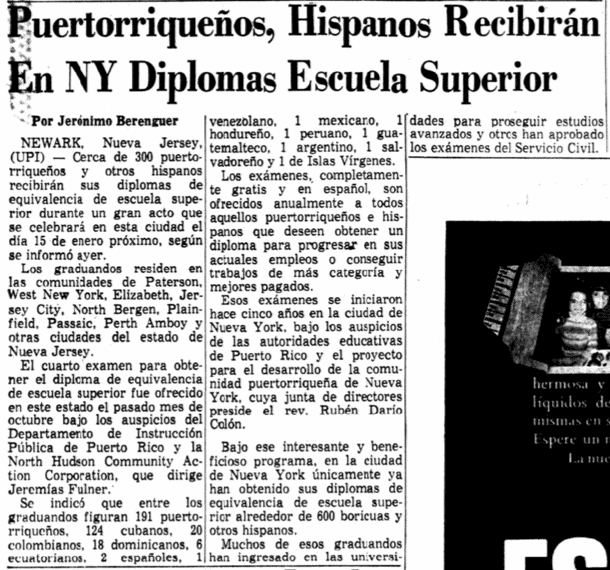
El Mundo. Dec. 19, 1969
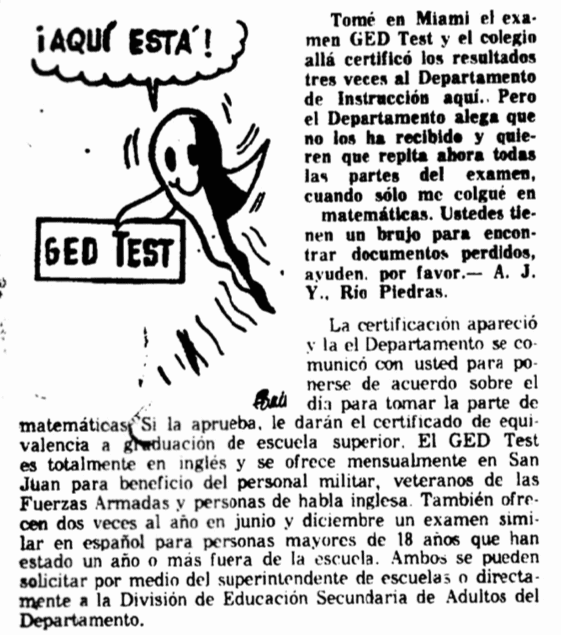
El Mundo. San Juan, Puerto Rico. Oct. 4, 1971. A reader’s letter on lost exam results.
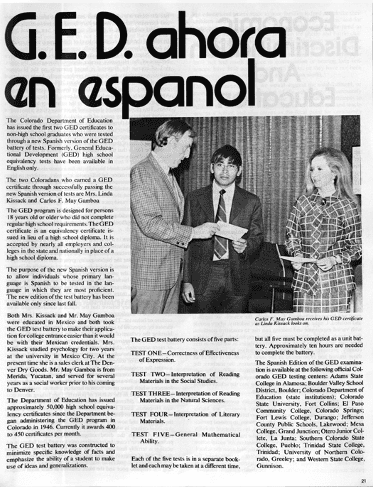
La Luz. Denver, Colorado. 1972.
Nevertheless, the exam is far from perfect.
We would be remiss if we ignored the problems that plague both the Spanish GED and its English counterpart. Specifically, the assessment fails in terms of representation and scope. As a GED instructor, I have never seen the U.S. Latino experience highlighted: questions dealing with the 60’s Chicano Movement, the demographics of Spanish Harlem, or Latino literature (Sandra Cisneros, Tomás Rivera, Richard Rodríguez) are completely absent. Latino history is nowhere to be seen in the GED’s telling of the American story.
In terms of scope, the exam mistakes reading comprehension for historical or civic knowledge. The Social Studies exam consists of reading comprehension questions thematized vis-à-vis U.S. history; ultimately, they test one’s ability to read, yet fail to assess whether students understand U.S. civic life. Actual questions as to facts and meaning of U.S. history’s greatest debates—say, women’s suffrage, the abolition of slavery, and the Space Race—would better serve all of our students but especially, our Latino ones.
The GED faces other difficulties—both politically and commercially. A 2011 joint venture between the American Council on Education and Pearson VUE effectively privatized the GED, giving rise to a booming market for official test-prep materials. An exploration of the executive circles of both organizations via Linkedin leaves one asking where education begins and business ends. More recently, the Trump Administration has reassigned adult learning programs from the Department of Education to the Department of Labor, signaling an ideological shift that prioritizes economic utility over pedagogical objectives. Just last summer, the Department of Education put GED, ESL, and Adult Education programs on the chopping block, before calmer minds eventually intervened. Fall 2026, too, may be characterized by renewed attempts at retrenchment.
Addendum: Where Can Education Take You?
For those who would benefit from the GED, finding an adult education center that offers classes in Spanish remains difficult. To my knowledge, no single website lists all the places that can help you obtain the GED en español. Indeed, the GED in Spanish, even after over fifty years of existence, is perennially described as new. A Fort Collins Coloradoan article from 2004 describes the exam as novel, as does a GED-preparation textbook from 1991. More than three decades after Nuyorican advocates won the right to test in their own language—a language central to the U.S. experience—the program was still being introduced to readers as something new.
A few final words of advice and encouragement.
Imperfect as it is, the GED test remains one of the most direct paths to a diploma, to college, and to better-paying work. Many of my students hope to continue their education at a community college or in the military; others are able to leverage pay raises. Test-takers do not need to find a physical center at all: the full GED can now be completed online and even proctored remotely if necessary. Each of the four exams is priced between thirty and fifty dollars depending on your state. English and Spanish tests can be mixed should you wish (i.e. a math exam in English, a Social Studies assessment in Spanish). Many states demand that a test-taker wait 2-3 months should you not pass a subject test after a third attempt. But there is always a way forward. Recently, there have been significant gains regarding Latino education achievement. Should you wish to bypass the GED given your previous certificates from locales outside the U.S., you may be able to have your education from abroad credentialized via one of various private organizations—a process known as homologación.
Hoping that this September also inspires pride in our educational successes.
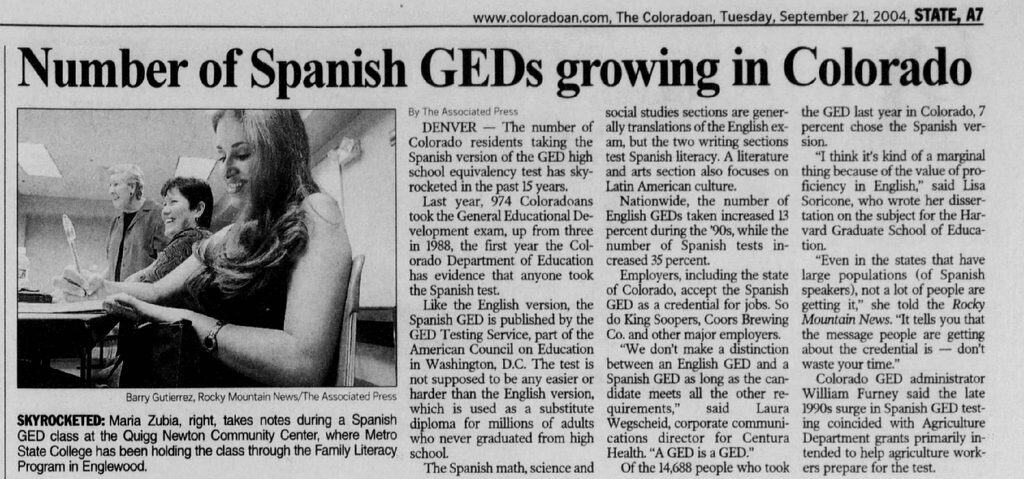
Fort Collins Coloradoan, Sept. 21, 2004
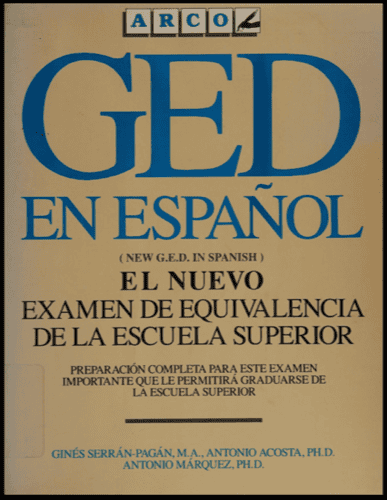
A GED textbook from 1991. The Spanish exam was still described as “new”
Embedded clippings are all from Newspapers.com
Kevin Anzzolin, Ph.D., is a Lecturer of Spanish in the Department of Modern & Classical Languages & Literatures at Christopher Newport University.
Featured Stories
Featured Stories
Noticias Newswire
Cosmetique Aesthetics Relocates to New State-of-the-Art Facility in Culver City and Launches Enhanced Digital Experience

Rita Moreno Headlines Hispanic Heritage Month Conversation at Lehman College Presented by HITN MEDIA
Great American Media Invests in Wholesome, Family Streaming Entertainment for Latinos with Launch of Pure Flix Familia