 Skip to content
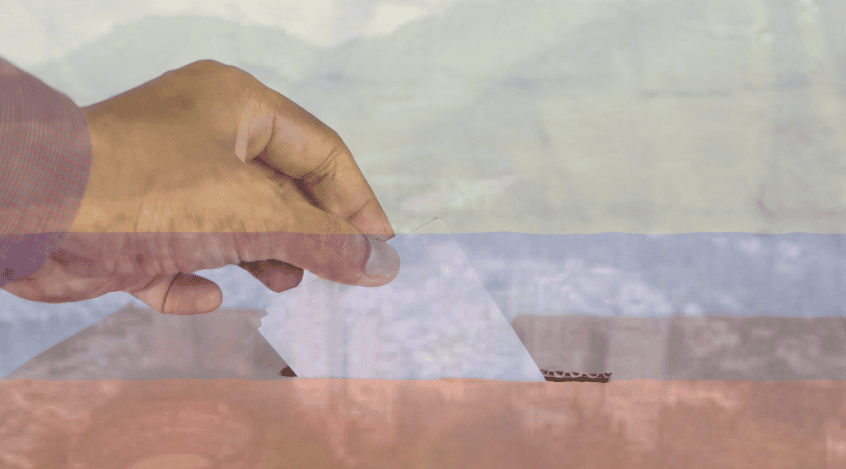
Like millions of Colombians living abroad, I followed the July 2026 election closely. I watched interviews, read social media posts, listened to friends and family give their opinion about the candidates, and tried to make sense of the flood of information from news outlets, WhatsApp groups, YouTube channels, and social media feeds. Distance does not weaken the connection; it shapes how you observe. You are no longer immersed in the day-to-day rhythm of the campaign—the conversations at work, the political discussions among neighbors, the headlines people wake up to every morning, and the constant stream of campaign messages that shape everyday life. Instead, you listen deeply, compare sources, read analyses, and try to understand what lies beneath the headlines.
Now that the election has concluded, I am reflecting less on the result and more on what the process revealed about democracy in Colombia. Three lessons stood out to me.
1. The Candidates Avoided the Conversations that Democracy Needs
The first lesson stems from what was lacking during the campaign: meaningful debate.

In a healthy democracy, election campaigns should provide chances for citizens to compare ideas. Candidates must be challenged publicly, defend their proposals, explain their priorities, and respond to criticism directly. That largely did not occur.
Instead of engaging in substantive debates where candidates would answer the same questions in the same setting, the leading candidates avoided these events, relying instead on interviews, social media appearances, and carefully managed communication strategies.
Interviews are not debates. For interviews, candidates generally select media outlets they are comfortable with. They can anticipate questions, redirect topics, and avoid tough issues. Debates differ in that they create a shared civic space where citizens can assess competing arguments side by side.
As a voter watching from abroad, I often felt I knew how candidates wanted to be seen, but I learned far less about how they planned to govern.
I knew their slogans. I knew their social media strategies. But I rarely had the opportunity to compare their proposals side by side or evaluate their plans for addressing Colombia’s most pressing challenges.
The campaign generated a lot of content but relatively little discussion. As a result, many Colombians compared performances instead of policies. Visibility often mattered more than substance. In this environment, viral moments generate more engagement than detailed policy discussions.
2. Fear Became More Powerful Than Hope
One troubling aspect of this election was how much fear influenced political decision-making. Many discussions were not about the future Colombians wanted to build. Instead, the focus was on the future that people feared the most.
Political scientists have long recognized that emotions play an important role in democratic participation. The problem is not that citizens bring emotions to politics. The problem arises when fear becomes the dominant lens through which people evaluate their political choices. Fear limits the ability to truly listen. It leads citizens and voters to see opponents as enemies instead of fellow citizens with different viewpoints. It prompts people to value certainty over curiosity and reaction over reflection.
As I watched discussions unfold online and among my friends, I often felt that many Colombians were voting against something rather than for something. Democracy deserves better than that.
3. Misinformation and Disinformation Filled the Void
The third lesson was perhaps the most worrisome.
The election showed how misinformation and disinformation have become significant players in political life. Throughout the campaign, Colombians experienced a constant flow of misleading claims, manipulated narratives, half-truths, rumors, and emotionally charged content. Without supporting evidence, some narratives tried to depict Senator Iván Cepeda as a guerrilla member. Other narratives promoted the image of Abelardo de la Espriella as an outsider disconnected from Colombia’s traditional political establishment, despite concerns about his long-standing ties to influential political and economic sectors. What matters is not figuring out which side was more responsible. Both supporters and opponents contributed to the problem. Some narratives aimed to harm opponents. Others were amplified to create sympathy, credibility, or emotional ties for a favored candidate.
In both instances, citizens were often urged to react emotionally rather than thoughtfully evaluating evidence. The result was a political atmosphere in which narratives frequently mattered more than facts.
The challenge was not just spotting false information but was understanding how information ecosystems reward content that provokes outrage, fear, or confirmation of existing beliefs. Falsehoods spread rapidly because they are emotionally engaging. Corrections spread slowly because they are often less exciting. In this environment, democratic participation becomes increasingly vulnerable to manipulation. Citizens are not just choosing between candidates; they are choosing between competing realities.
Democracy Needs Better Conversations
Watching Colombia’s election from afar reminded me that democracy involves much more than voting. Elections are crucial, but the conversations that happen before elections are just as, and possibly even more, important. The health of a democracy depends on whether citizens can engage with evidence, listen to opposing views, evaluate competing proposals, and discuss shared challenges. This election revealed significant weaknesses in those democratic practices: fear often replaced hope, political performance often replaced debate, and narratives often replaced facts.
Yet these issues are not unique to Colombia. They reflect broader democratic trends in many societies. For this reason, the lessons from this election extend beyond the country and the region.
If we want stronger democracies, we need better public conversations. We require spaces where disagreement is possible without hostility, where evidence is valued more than rumors, and where citizens are motivated to think critically instead of reacting emotionally.
As a Colombian living abroad, I watched my country make an important democratic choice.
But the question I am left with is not, Who won? It is: Are we building the conditions for citizens to make future choices through discussion instead of fear, through dialogue rather than spectacle, and through evidence rather than misinformation? The future of democracy may depend on how we respond to that question.
This article was originally published as part of Resilience & Resistance, a Charles F. Kettering Foundation blog series that features the insights of thought leaders and practitioners who are working to expand and support inclusive democracies around the globe.
A Colombian social researcher living in Montreal, Catalina Arango Patiño holds a master’s in communications and media studies from the University of Ottawa. She has led research projects in the US, Canada, and Colombia on human rights and the role of information, communication, and technology in diaspora communities. Currently, she works as a consultant on academic freedom across the Americas.
