 Skip to content
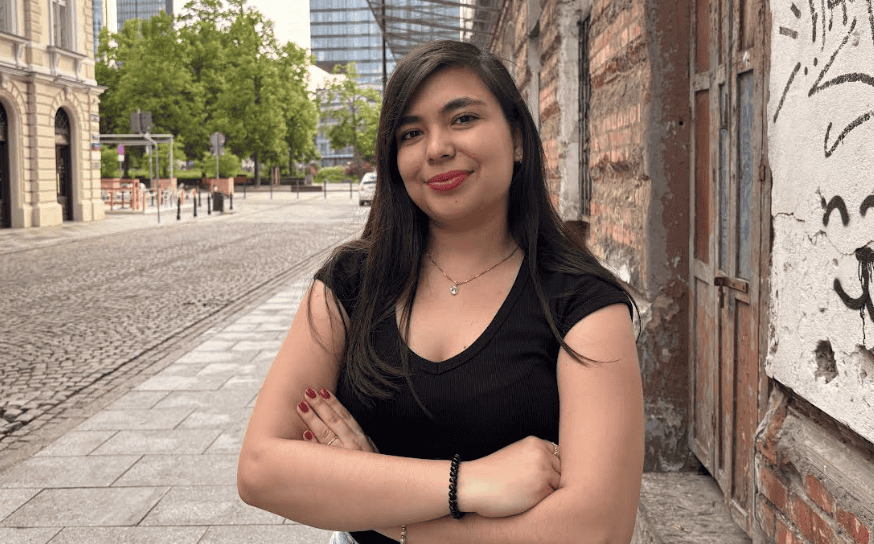
Born into a Christian family in Mexico, Samantha Rodriguez was not raised Jewish. However, after deep historical dives and several family trips, she uncovered a part of herself she never knew existed.
Her family took it upon themselves to uncover the past of her maternal great-grandfather. “We had no idea about that connection or if there was any extended family, because my grandmother and her siblings had been raised Catholic,” Rodriguez said.
Her great-grandfather, Marco Schtulmann, was an enigma. Her family initially believed he was from Russia, until archives revealed he was born in a Polish town during the Soviet occupation. Further research led to a surprising revelation: all of her great-grandfather’s ancestors were Jewish.
Most people have traditions passed down through generations, but for Rodriguez, none of her Jewish heritage was inherited. She believes her great-grandfather sought a fresh start after the tragedies that befell his family; he likely feared being identified as Jewish, even while living in Mexico.

“I believe that’s the story for many people, too,” Rodriguez said. “I even know people in Poland who don’t even realize they are of Jewish descent because their grandmothers or mothers didn’t tell them out of fear.”
She feels this history was lost because her ancestors chose to protect their descendants from persecution rather than withholding information out of malice.
In 2015, when Rodriguez—alongside her aunt, uncle, and mother—first became curious about their heritage, they began scouring genealogy websites, contacting embassies, and checking Mexican immigration records. Despite having little information, they eventually located his village in Lublin, Poland.
The family’s curiosity is not unique; DNA ancestry test-takers make up approximately 16% of the U.S. population, according to a 2019 estimate by the Pew Research Center. Rodriguez and her family are among the millions using services like 23andMe and Ancestry.com to discover their origins.
Following their discovery, the family traveled through Europe in 2016, visiting Warsaw before seeing her great-grandfather’s village. “It was beautiful to be in the place where he was born and lived, even though we knew so little,” Rodriguez said.
In Warsaw, details emerged via the POLIN Museum and the Jewish Historical Institute. They learned her great-grandfather’s Jewish-Polish name, Moszko Ajzyk Sztulman, and discovered he had nine siblings—most of whom were murdered by the Nazis.
It wasn’t until 2017 that they found his exact address. Although the original home was gone, the empty lot remained full of history. “Being at the very locations where they had once lived was an incredible experience for us,” Rodriguez recounted. She says that year defined why she stayed.
She specifically remembers Lublinia, an event organized by the Grodzka Gate – NN Theatre Centre for Jewish descendants tracing their roots. Two hundred people from around the world attended. While many grew up knowing their history, others, like Rodriguez, discovered it later in life. “Meeting descendants of families like ours—people coming from every corner of the globe—was remarkable,” Rodriguez said.
Her travels inspired her to learn from non-Jewish Poles committed to researching Jewish history. What began as a personal education—reading books and listening to witness accounts—soon evolved into a larger mission.
During the pandemic, she envisioned an online interview project with Holocaust survivors. Despite having no initial connections to the Jewish community in Mexico, she used Facebook to share her vision and search for participants.
The responses were overwhelming. Starting with a 90-year-old survivor who reached out on Facebook, the project has flourished over five years into a collection of over 100 interviews featuring survivors, descendants, historians, and filmmakers.
Rodriguez did not grow up with Jewish traditions or culinary heritage, yet she maintained a deep respect for the culture. “It was always something positive, a matter of supporting the Jewish people,” Rodriguez said. “For me, it was an honor — and a driving force — to do something to share this story.”
Now a resident of Poland for two years, she has cultivated a profound connection to the Jewish community. She raises Holocaust awareness on social media, serves as a Spanish-language guide at the Majdanek Concentration Camp, and conducts tours of Lublin’s Jewish history.
While the Holocaust is a global historical pillar, it is often overlooked in Latin American curricula. UNESCO found the topic underdeveloped in Mexico, noting widespread indifference or misinformation regarding the history of the Holocaust and genocide within the national educational system.
“They need to realize the sheer magnitude of the Holocaust,” Rodriguez explained. Unlike other mass killings, the Holocaust was a systematic attempt to annihilate an entire population across Europe. “It is something unparalleled — before or since — and I hope it never happens again.”
Though she is thousands of miles from home, her family is proud of her—not just for uncovering this story, but for doing something about it.
“Living here, speaking Polish, and dedicating myself to this is something I never expected,” Rodriguez said. “I never thought I’d end up living here, but everything led me here naturally. Little by little, I feel that this is now my life’s mission.”
Alessa Alluin is a San Diego native currently in her third year at NYU. She is a writer and copy editor for her school newspaper, Washington Square News, where covers arts, culture, and news. Alessa is also the editorial director for Bite Club, an online food publication at NYU, as well as a tutor helping kids with reading, math, and Spanish translation for immigrant children. When she’s not busy with school, work, or any of her other obligations, she enjoys watching movies like she has with her mother growing up or spending time with friends exploring the city.
Alessa was a fellow with Fuente Latina, an organization that sponsors journalists and students to visit Poland and learn about the Holocaust and Jewish history in the region.
