Skip to content

Share This Story, Choose Your Platform!
Chuy Renteria started dancing-specifically breaking-at the age of 14. A magazine editor and writer these days, Renteria still uses breaking to express his identity-and defiance, rebellion, and frustration with the other dancers.
“We’re in conversation. We’re having the equivalent of a heated argument on the dance floor,” he says. The improvisational street dance is rooted in African American and Latino culture. It originated in New York City in 1980s, alongside a growing hip-hop scene.
Renteria dances to engage with the labels pasted onto him, both accurate and biased.
“When people see me walking down the street, they can’t help but think A, B, C, right? So when I go to sleep and I wake up, I can’t take that away,” he says.

‘This is Me’
Renteria grew up in West Liberty, Iowa, in the 80s and 90s-a time and place that has shaped who he is and where his art leads him.
The city is less than two square miles in size; inside is a historically majority Hispanic population.
“Growing up in West Liberty, I felt too Mexican for the white people and too white for the Mexican people. And that was always this constant [existence] between those spaces,” Renteria says.
As young as nine years old, the first-generation Mexican-American remembers racial slurs being flung at him. People would say they hated him.
“And when I found dance, it transcended all of that,” he says. “It’s like, this is me.”
Finding Meaning
Renteria shares: “Just by nature of my own identity, in the context of the social constructs around us, me existing becomes this political conversation point to folks.”
But that politicization isn’t as direct a translation in dance as, say, artforms that use words or visuals. The dialogue is more subtle.
“Dance and movement, and that sort of expression, is just as valid, and it’s just as politically cognizant of the world. It just does it in this kind of abstraction. It doesn’t have to be hitting you over the head,” he says.
Renteria’s 2021 memoir We Heard It When We Were Young, along with his more recent blog posts in Of Spanglish and Maximalism, grapple with his past, the now, and beyond.
What is identity? How does intergenerational trauma and racism impact who we are? The list goes on: “Did I have a good childhood? Am I a good person because-or in spite of-my upbringing? … Is my town a good town? The town that I grew up in, the town as of now, is it a good place?” Renteria asks.
“I’m really interested in the questions that I don’t know the answer to.”
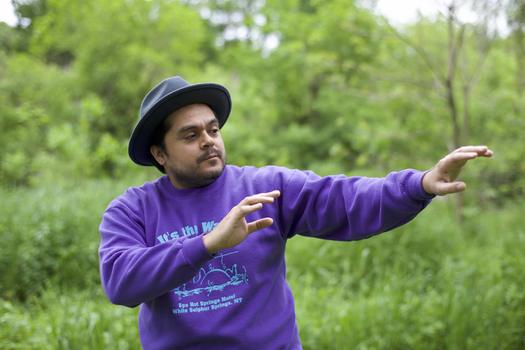
Cover Photo: Iowa ‘dance fighter’ Chuy Renteria interprets his world through performance art. (Chuy Renteria)
Iowa ‘dance fighter’ interprets his world through artform was first published by Public News Service, and republished with permission.
Frankie (Amy) Felegy wrote this story for Arts Midwest.
Featured Stories

Latino Growth Spreads Across the U.S., New Pew Data Shows
Couple inspire generational achievement through education
Children’s Author Cindy L. Rodriguez On Multidimensional Latinx Representation

Voting is a social determinant of health
Stay Connected
Noticias Newswire
El español Marc Paré Rico gana el Aloha Classic y refuerza su liderato en la lucha por el título mundial de windsurf en Hawái

B-fit Strengthens Its U.S. Presence and Brings Its Inositol Line to the Hispanic Market

Remittances Reach Well Beyond Major Cities as Older Users Send Money More Frequently