Skip to content

Share This Story, Choose Your Platform!
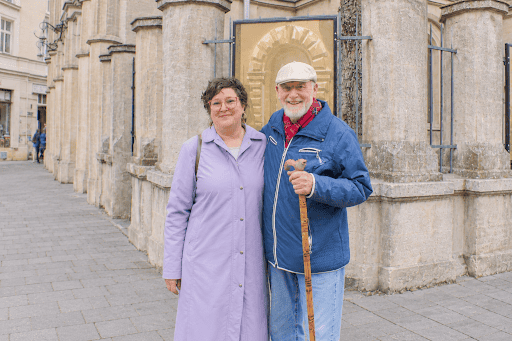
During my recent trip to Poland, I had the opportunity to meet Bernard Offen, a survivor of the Holocaust who became much more than just an interview subject to me.
Prior to hearing Bernard’s story, I found myself in one of the darkest periods of my life. I felt worthless and hopeless, beginning to doubt whether basic human kindness was worth the energy when it seemed unreciprocated toward me or my community.
Bernard experienced the horrific reality of the Holocaust, losing his father, mother, and sister. Throughout his storytelling, he focused on the importance of compassion, courage, and those who risked their lives to help others.
Beyond sharing his personal experiences, Offen has dedicated his life’s work to encouraging younger generations to confront hatred, recognize the dangers of indifference, and understand their personal responsibility to protect human dignity. His message not only reassured me but also reshaped my perspective on daily life.

I believe it is vital to educate ourselves and others during times of war and political division. In today’s climate, there is widespread hatred, confusion, and misinformation directed at people of various nationalities and beliefs.
“If you don’t start looking at other people and make the heart [to heart] connection that we all have [to one another], whether you like it or not, that is the beginning of hatred for others and separation of others,” claimed Offen.
Offen’s message about human connection extends beyond historical accounts of hatred. It serves as a reminder of how easily divisions can develop in modern societies, particularly when political rhetoric encourages people to view others as opponents rather than human beings.
Whether through international conflicts or domestic political divisions, the consequences of dehumanization extend beyond borders. When people are reduced to political labels or viewed solely through the circumstances surrounding them, their individual experiences and humanity can be overlooked.
“Imagine a blackboard and on that blackboard is written anti-jewish, second word anti-american, anti-black, anti-chinese, anti- and you go on and on through all the anti’s that you can place on there. When you erase the [root word] what you are left with is Anti, it is a position of ANTI- HUMAN.”
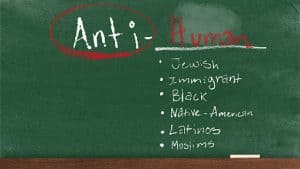
Illustration: Jessica A. Valencia
The consequences of this mentality are not limited to international conflicts. They can also be seen in domestic policies and the rhetoric surrounding immigration, where entire communities can be targets of political division and public scrutiny.
This mindset is evident in the consequences of the One Big Beautiful Bill Act, enacted last July by President Donald J. Trump. The legislation increased the ICE budget, accelerated the removal of undocumented Americans, and spurred a pro-ICE sentiment across the country.
This rhetoric has deepened the nation’s immigration divide, often obscuring the individual lives behind legal statuses. As a resident of Oxnard, a vibrant agricultural community of farmworkers, I see daily the importance of seeing the human beings involved in these debates. My neighbors and community members have their own stories, struggles, and families—none of which should be reduced to political stereotypes.
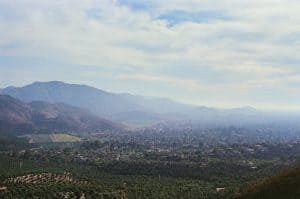
A skyline overview of the agricultural beauty of Oxnard, Calif. (Credit: Jessica A. Valencia)
Trump has fueled pro-ICE sentiment by claiming that ‘Illegal immigration affects the lives of all Americans and causes burdens to American tax dollars, local schools, hospitals and communities by taking billions of dollars each year.’
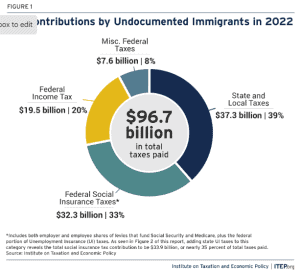
However, data from the Institute on Taxation and Economic Policy (ITEP) presents a different picture. Undocumented residents contribute nearly $97 billion in taxes despite being ineligible for many tax credits. Furthermore, many are unable to claim tax refunds due to concerns regarding their immigration status.
Beyond tax contributions, undocumented residents play a crucial role in sustaining local economies. As ICE activity increases, fewer undocumented residents venture into public spaces, creating ripple effects that impact local schools, businesses, and workers.
“One of our volunteers is one of the maintenance guys in the school district, he got his hours cut,” said Leonardo Martinez, a volunteer with VC Defensa, an organization created to support communities facing ICE activity in Ventura County. “He went weeks without work because the attendance of schools had tremendously decreased.”
The decline in school attendance is just one example of how enforcement actions affect daily community life. Similar disruptions affect theaters, swap meets, and local or national Latine cultural centers and businesses, leading to lower revenues and forcing some to close.
While these challenges continue to impact communities, education remains a vital tool for understanding history and recognizing acts of humanity during dark periods.
That is the premise behind Bernard Offen’s educational initiative, “Love, Light and Courage,” which highlights acts of humanity and moral bravery during the Holocaust. His lifetime of activism—including his opposition to nuclear weapons—informs his perspective on what he describes as modern “evilzation.”
“As a journalist you are [meant to] write civilization with a capital c but i write it with a very small c, because it is a very primitive and stupid civilization, and we are all part of it and what we do with it,” stated Offen. “I think we need to go back up in the trees for a thousand years before we call it a civilization, I call it an evilization [because, the world leaders do not care about us, to them we are just another number]”
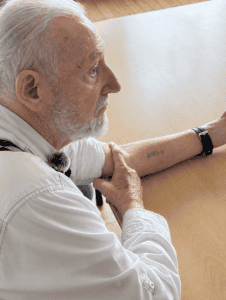
Bernard Offen shows off a tattoo reading “B-7815,” his identification number from Auschwitz-Birkenau.
In a world where political divisions, conflict, and misinformation shape how we perceive our neighbors, Offen’s message serves as a reminder that humanity should not be defined by nationality, religion, political affiliation, or immigration status. Recognizing humanity in others begins with a willingness to understand their experiences, regardless of how much they differ from our own.
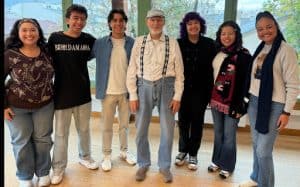
(Left) From left to right, Lilly Molina, Tadeo Cabrijo, Nicholas Hernandez, Bernard Offen, Jessica A. Valencia, Malory Shaw, and Ianis Soto meet and interview Offen. (Credit: Maria Morales, Fuente Latina)
–
Jessica A. Valencia is a recent graduate from California State University.
Jessica was a fellow with Fuente Latina, an organization that sponsors journalists and students to visit Poland and learn about the Holocaust and Jewish history in the region.
Featured Stories

Latino Growth Spreads Across the U.S., New Pew Data Shows
Couple inspire generational achievement through education
Children’s Author Cindy L. Rodriguez On Multidimensional Latinx Representation
Voting is a social determinant of health
Stay Connected
Noticias Newswire
reVolver Podcasts Expands Spanish-Language News Programming with Politics en Español US

Canela.TV Debuts Vertical Micro-Series Featuring Fantasy, Sci-Fi and Anime Romance

Murals for Humanity Honors Miami’s Unsung Heroes: Celebrating the Visionaries Who Shape Our Cultural Landscape