 Skip to content
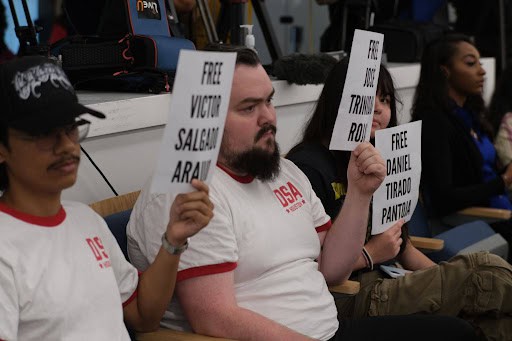
HOUSTON — The sons of a Houston construction worker fatally shot by federal immigration officers urged members of Congress on Friday to demand an independent investigation with full cooperation from ICE and the Department of Homeland Security.
“How many more of our dads have to die? How many more children have to wait hopelessly for answers?” Ronaldo Salgado, one of Araujo’s sons said during a congressional field hearing in Houston.
Lorenzo Salgado Araujo, 52, was shot and killed July 7 during an ICE operation in Houston’s East End, a predominantly Latino community. Federal officials have said officers opened fire after he used his van as a weapon, but his family and three workers who were inside the vehicle have disputed that account. In a separate incident six days later, ICE officers shot and killed the 25-year-old Johan Sebastián Durán Guerrero in Maine.
Juan Proaño, CEO of the League of United Latin American Citizens, said the Houston shooting was part of a broader pattern rather than an isolated encounter. Public reporting has documented at least 30 incidents since mid-2025 in which federal immigration officers fired at people, killing at least eight and injuring at least 14, he testified. Agents also held bystanders, protesters or others at gunpoint in at least 46 additional incidents, he said.

The field hearing, convened in Houston’s Harris County by the Congressional Hispanic Caucus and Democratic members of the House Homeland Security Committee, focused on Immigration and Customs Enforcement’s use of force, the absence of body-camera footage and the federal government’s handling of evidence. ICE, DHS and the FBI representatives were invited but did not attend. Republican committee members were also absent.
In a statement to Medill News Service, DHS said the Office of Inspector General is leading an investigation into the agent-involved shooting and FBI Houston is leading an investigation into the potential assault on a federal law enforcement officer.
But Araujo’s family said that was not enough.
“There must be a thorough, truly independent investigation, not one where the agency under investigation also controls the evidence and is able to unilaterally clear its own personnel and wrongdoing,” Araujo’s son Ronaldo Salgado said. “Congress should insist that federal, state, and local investigations all move forward with full federal cooperation.”
Harris County District Attorney, Sean Teare, said the Department of Homeland Security had provided his office no evidence about the killing.
Teare said federal officers did not invite his investigators to the shooting scene, departing from the procedures normally followed after a law enforcement officer kills someone.
“That was not OK,” Teare testified. “It can never be the case that a life is taken by a law enforcement officer and a proper, independent investigation doesn’t immediately exist.”
Teare said his office has asked DHS for information repeatedly but has received no response. Federal authorities had not identified the officer who shot Araujo, told local investigators whether the officer remained on duty, nor provided access to the vehicle and other evidence, he said.
Teare contrasted the response with a 2018 case in which an FBI agent mistakenly shot a kidnapping victim in Harris County. In that case, local prosecutors were brought into the investigation immediately, he said.
“This didn’t happen that way at all,” Teare said.
Teare’s office opened an independent investigation July 8 and has collected surveillance video, cellphone footage and witness accounts with assistance from the Texas Rangers, Houston police and other local agencies. Teare said the investigation was progressing rapidly but declined to discuss possible charges or a timeline.
DHS told Medill News Service that Salgado Araujo “rammed an ICE law enforcement vehicle, refused to follow multiple verbal commands, and weaponized his vehicle in an attempt to run over an ICE law enforcement officer resulting in our officer firing his weapon in self-defense.”
Salgado Araujo’s sons told the committee that their father would have stopped if the ICE officials had clearly identified themselves, but he and three co-workers were intercepted by two unmarked vehicles. He was then shot and transferred to the hospital where he passed away because of injuries. The three other men in the vehicle rejected ICE’s version of what happened. The workers were immediately detained by ICE. Araujo’s sons said those workers must be allowed to speak to investigators without fear of deportation.
Rep. Sylvia Garcia, D-Texas, said her office and congressional committees had sent six letters to DHS seeking records or answers from federal authorities, including one signed by 180 lawmakers. None had received a response, she said. DHS did not respond to Medill News Service regarding the letters.
Community witnesses said the shooting had deepened fear in Magnolia Park and other East End neighborhoods, where residents were increasingly afraid to drive to work, attend church, seek medical care or cooperate with police.
Rep. Al Green, D-Texas, said Salgado Araujo had been “profiled” and “hunted.”
“He was the prey of the day,” Green said. He called the killing “an extrajudicial execution,” arguing that Salgado Araujo had received neither due process nor a trial.
Green also called for body cameras and dashboard cameras in vehicles used during immigration operations.
“It is a part of a bigger picture that we have failed to embrace properly,” Green said. “The President of the United States of America is engaged in ethnic cleansing.”
The sharpest reaction from the audience came near the end of the hearing, when a man seated among local activists shouted, “Call it what it is. American Gestapo.”
Marcus Cole, a member of the Houston chapter of Democratic Socialists of America who was seated in the audience, said afterward that ICE had become an increasingly unaccountable national police force.
“It is the ‘American Gestapo,’ in a way, where it’s our new secret police,” Cole, 29, said. He described ICE as a force operating across the country with little meaningful oversight and primarily accountable to the executive branch.
Ricky Sanchez, 26, another member of the Houston chapter of Democratic Socialists of America, compared ICE officers to slave catchers operating under fugitive slave laws before the Civil War. Those laws authorized the capture and return of people who had escaped slavery and also exposed free Black people to kidnapping and wrongful detention.
“We’re going to organize ourselves to make sure that we have a response,” Sanchez said.
The government is ”supposed to represent us, and we’re going to make sure (it) does something.”
Yuqing Liu is a reporter for the Medill News Service.
